


Hannah lived at the end of the period of the Judges (approximately 1100 B.C.) in Israel. The Bible records her story in 1 Samuel. Many women (and their husbands) will relate to Hannah’s story because she was barren. Even though their society had rejected God (“Everyone did what was right in his own eyes,” according to Judges 21:25, ESV), Elkanah and Hannah were faithful followers (1 Samuel 1:3).
Elkanah was a Kohathite of the tribe of Levi (1 Chronicles 6:33-35) and lived in the hill country of Ephraim (which is why Elkanah is also called an Ephraimite; see 1 Samuel 1:1). As a Kohathite, Elkanah’s life revolved around the tabernacle, caring for the furniture, including the Ark of the Covenant. Various families in the clan would take turns fulfilling these duties (Numbers 3:30-31). The tabernacle was in Shiloh which was centrally located to enable the various Israelite tribes access to worship and sacrifice, especially during feast times. Elkanah lived in Ramah which was 15 miles south of Shiloh, and he and his wife made the yearly journey to “the house of the Lord” with their offerings.
Hannah’s Problem
In Israel, children were a symbol of God’s blessing, and Israelite women dreamed of birthing the Messiah. For a Jewish family, children are one of life’s greatest blessings, and Hannah was missing out. In some instances, barrenness was reason enough for a husband to seek a divorce. Like Sarah, Hannah longed for the fulfillment of having children and growing a family. All the while, Elkanah had a second wife, Peninnah, who had children. To add insult to injury, Peninnah used these feast times to provoke Hannah “grievously” (1 Samuel 1:6), ridiculing her because she had no children, a taunting which went on “year after year” (1:7).
Elkanah felt his wife’s sorrow and tried to comfort her in his own way. He gave her double portions of food to reassure her of his love saying, “Hannah, why do you weep? And why do you not eat? And why is your heart sad? Am I not more to you than ten sons?” (1:8, ESV). He was not unaware of her sorrow but was oblivious to the real problem. However, Elkanah got one thing right: ongoing dedication to coming before God at the tabernacle at Shiloh. This was to bring Hannah to a time and place for healing.
“In Israel, children were a symbol of God’s blessing, and Israelite women dreamed of birthing the Messiah.”
Hannah’s Petition
According to Scripture, “…the Lord had closed her womb” (1 Samuel 1:5, ESV). So, in this case there was only one place for Hannah to go for help: to God. One year, during the annual feast in Shiloh, Hannah took her plight to the Lord. This choice alone makes Hannah a worthy example for anyone who carries a burden of pain and sorrow. Our pain should point us to the One who provides wholeness, if we will let Him.
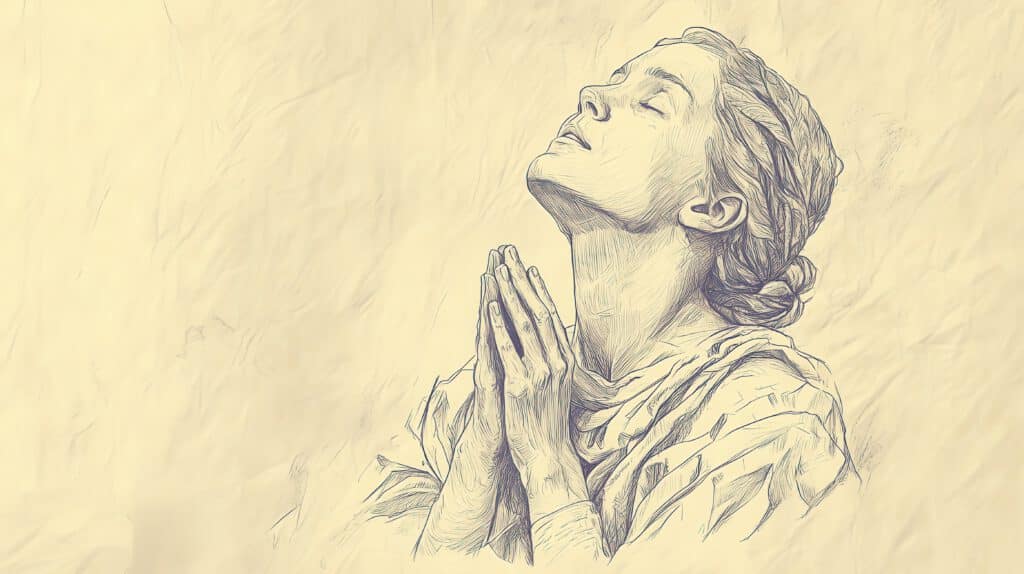
Hannah no longer had the emotional will or strength to participate in the family celebration of God’s blessing and faithfulness that Elkanah enjoyed so much. She could no longer tolerate the festivities, and she couldn’t eat. To make matters worse, her sorrow rewarded Peninnah and further humiliated Hannah. After the meal, Hannah made her way to the tabernacle. “She was deeply distressed and prayed to the Lord and wept bitterly” (1:10, ESV). The same description has been used in Scripture upon the death of a child (Ruth 1:13, 20; 2 Kings 4:27; Zechariah 12:10). God is the only One who can lift this kind of sorrow.
One can imagine she might have thought of the tabernacle, a reminder of the power and protection of Almighty God. Perhaps she remembered the stories of her ancestors, even an ancestor named Sarah, generations before, who had endured the same emptiness she felt. Carrying that burden and making it a part of her life had finally become unbearable; she’d had enough of it. She had come to the end of herself, and she poured out her soul before the Lord.
“She had come to the end of herself, and she poured out her soul before the Lord.”
Hannah’s Promise
That day, Hannah made a vow, saying, “O Lord of hosts, if you will indeed look on the affliction of your servant and remember me and not forget your servant, but will give to your servant a son, then I will give him to the Lord all the days of his life and no razor shall touch his head.” (1:11, ESV).
By making her promise to the the “Lord of hosts” (ESV) or “Lord Almighty” (NIV), she was recognizing God’s authority over her circumstances. She had the courage to ask for a son, but she also had the courage to promise to give him back to God. And God “remembers” her. “Remembers” means to take notice, consider, or pay attention.
Seated nearby, the high priest Eli saw Hannah’s lips while God saw her heart. The result of this outpouring in prayer was a change of her very being. Before Eli could pronounce a priestly blessing upon her, God had already worked in Hannah’s heart. As she took her pain and anguish to the Lord, He helped her realize what her true need was. She needed to be content with God Himself. Her vow to God shows she was no longer seeking merely her own desire; she was offering an unselfish sacrifice. The son, whether a desire in her heart or a baby in her arms, would belong to God.
“The son, whether a desire in her heart or a baby in her arms, would belong to God.”
Although she likely asked God for a child before, her words and actions this time reveal a change in her heart and life. She had put her desire for a child into the Lord’s hands to the point that she had given him up before she even had him. Her desire changed from, “Give me what I want” to “My child belongs to you.” Even if God had never granted that petition, Hannah had settled it in her heart. From her perspective now, the child belonged to God whether or not he was ever born. She let go of her son before she ever saw him, and in doing so she made her peace with God.
Hearing her sobbing and cries to the Lord, Eli the priest reprimanded her. He assumed she was in a drunken stupor. But she answered him from her heart, explaining that she had been crying out to God “out of my great anxiety and vexation” (1:16). This time with warmth and understanding, Eli pronounced his blessing upon her, asking that God grant her petition. But God had already worked in Hannah’s heart. In this section, beginning with the vow, Hannah referred to herself as “your handmaiden” or “your servant” multiple times. Acknowledging her own helplessness in humility, she lifted God up as her only recourse because only God has power over life. And no human being has the right or power to force God to do anything.
Hannah’s Permanent Peace
We can see in Hannah’s vow an act of surrender of her own desires to God. I believe this surrender was largely the basis of the peace that replaced her sorrow. She returned to her family and their celebration “and ate, and her face was no longer sad” (1:18, ESV). This wasn’t a typical “bargain” with God. When we make a bargain with God, we usually put conditions on our trust. “If you give me what I want, I will trust you.” This puts us in the driver’s seat while we fool ourselves into thinking we are trusting God. When we accept that we have no power to change anything, and when we humble ourselves to turn our grasping into worship, we have peace.
Elkanah and his family returned to their home, and Elkanah loved his wife again. A son was born: “She called his name Samuel (“God has heard”), for she said, “I have asked for him from the Lord” (1:20, ESV). She did not make the trip to Shiloh when the rest of her family went to make offerings, until the boy was weaned, which was probably around three years old.
Hannah took Samuel to the priest after he was weaned, with an offering of a three-year-old bull, an ephah of flour, and a skin of wine. As she presented her son to Eli, she said,
“Oh, my lord! As you live, my lord, I am the woman who was standing here in your presence praying to the Lord. For this child I prayed, and the Lord granted me my petition that I made to him. Therefore I have lent him to the Lord. As long as he lives, he is lent to the Lord.” (1 Samuel 1:26-28, ESV)
“As long as he lives, he is lent to the Lord.”
Samuel knew the steadfast love and care of his mother, even from a distance. She made robes for him and brought them to him each year when she went up with her husband to offer the annual sacrifice (2:18-19). God further blessed Elkanah and Hannah with three more sons and two daughters (2:21).
Hannah made her vow for life. Most vows were temporary, including the Nazarite vows that were made by the Israelites to show devotion to God (Numbers 6:2-20). Although Old Testament vows were voluntary and were not made to obligate other people, between Hannah’s prayers and influence over her young son and God’s work in his heart, Samuel served God his entire life as an honorable and powerful prophet, a leader of Israel. 
Hannah’s Praise
Hannah had gone “before the Lord” with her request. Long before she brought Samuel to Eli, she had given her heart to the Lord. Samuel was presented to the Lord (1:24) and he remained “before the Lord” always (2:11,18, 21). Elkanah and Hannah, with great delight, fulfilled the vow Hannah had made. The generous offering and the joyous prayer of praise gives testimony to the condition of Hannah’s heart. Hannah’s prayer expresses her complete delight in the Lord. The prayer is one of the longest in the Old Testament and lifts up God’s name, Yahweh, 18 times.
Hannah’s prayer of praise also provided a model for Mary’s praise song in Luke 2. Both women understood that their first-born sons belonged to God. A sermon in itself, Hannah praises God for the attributes that prove He is able to bring about help and comfort, as well as salvation. The song acknowledges the One true God and gives us a model for worship as well.
“I rejoice in Your salvation” (2:1b)
“There is none holy like the Lord” (2:2a)
“There is no rock like our God.” (2:2b)
“The Lord is a God of knowledge.” (2:3b)
“He brings low and he exalts” (2:7b)
“Hannah’s prayer of praise also provided a model for Mary’s praise song in Luke 2.”
Why Hannah?
Why would this narrative about God’s ability to close a womb and open a womb be important enough that it was included in their sacred scriptures? Besides the fact that it was written by Samuel, and would verify his place as a prophet and leader, it also carried a message to God’s broken people. For those who cared to notice, God proved that He was in control—long before the prophet’s birth and every moment after. The miraculous way God placed mighty men and women in their midst should have been for them a proof of His power and faithfulness to His people. These should have helped them desire to be men and women who pleased God. Their hearts should have been moved, as Hannah’s was, by who their God was. Sadly, often they took Him for granted, as they did the prophets He lent them.
Everything about Hannah’s life provides inspiration and example for men and women today as well. The fact that she felt deep, unmet longings was not wrong. Her story has shown us a way to handle our deepest sorrows and what to do with our unmet desires. God answered Hannah’s heartfelt prayer by providing for the need she never realized—the need to delight in the Lord.
“God answered Hannah’s heartfelt prayer by providing for the need she never realized—the need to delight in the Lord.”
We want many things, but they may be only a shadow of what we need the most, the needs only God can fulfill. When we make that difficult shift to put God at the top of our want list, life becomes bearable. We don’t have to ignore our other desires, but we cannot give them first place in our lives, our plans, our dreams, because they will not fulfill our deepest need. If God were to personally ask you to trade in your deepest longings for a deeper relationship with Him, would you accept? David’s psalm would be a good answer:
“As for me, I shall behold your face in righteousness; when I awake, I shall be satisfied with your likeness.” (Psalm 17:15, ESV)