

Who were the Pharisees? Ask that question in a Bible study at pretty much any church and you’re likely to hear answers like:
“Hypocrites.”
“Legalists.”
“Self-righteous religious leaders who opposed Jesus.”
In short, the Pharisees are the “bad guys.”
In Christian circles, to describe someone as a “pharisee” is no compliment. It’s usually a way of criticizing them for being self-righteous and legalistic.
But all of this paints a caricature of the Pharisees in Jesus’ day. So, who were the Pharisees, really?
To answer that, we first need a little backstory. When you open the pages of the Gospels in the New Testament, the world feels different from when we left off in the Old Testament. There’s seemingly new geography (Galilee, Samaria, Judea), new government (Caesar Augustus, Herod, etc.), and new groups of people (Sadducees, Pharisees, etc.). And the reason for all of that is there has been 400 years of history for the Jews since the end of the Old Testament.
During those centuries, the Jewish nation was under the control of various world and regional powers. Persia liberated them from Babylon and allowed them to return home and rebuild, but they didn’t have full independence. Then the Greeks swept through the Mediterranean world pushing out the Persians. But not long after that, Alexander the Great died, his kingdom was divided up, and over the ensuing decades Israel got kicked back and forth like a soccer ball between the Seleucid kingdom to the north and the Ptolemies in the south.
“When you open the pages of the Gospels in the New Testament, the world feels different from when we left off in the Old Testament.”
The Jews were oppressed and at times treated brutally. Foreign powers ruled over them. Pagan idolatry defiled their land. One ruler sacrificed a pig on the altar in Jerusalem, rendering the entire temple unclean and unfit for worship. Circumcision was outlawed on threat of death to the baby. Horrific events ensued.
How should Jews respond to all of this if they want to survive and be faithful to God?
A few chose accommodation and cooperation with the ruling powers. Usually these had wealth and power and a lot to lose.
Some pursued holiness and ritual purity, believing God would rescue them and fulfill his promises if they faithfully kept the Torah.
Others chose revolt, with only occasional, short-term success.
Still others chose to withdraw to the desert and pursue purity away from it all.
Out of this intense, real-world pressure, diverse Jewish groups or sects emerged. And the various groups we meet in the Gospels find their roots in these differing responses to the events of the centuries between the end of the Old Testament and the beginning of the New Testament. All such groups had their own vision of what it meant to live faithfully as the covenant people of God.
Which brings us back to the Pharisees.
Their roots appear to be a Jewish purity movement known as the Hasidim. By the first century, the Pharisees had grown into a sizable and influential group of about 6,000 men. They were one of the major parties of first-century Judaism, and their goal was to be as holy as they possibly could.
“They were one of the major parties of first-century Judaism, and their goal was to be as holy as they possibly could.”
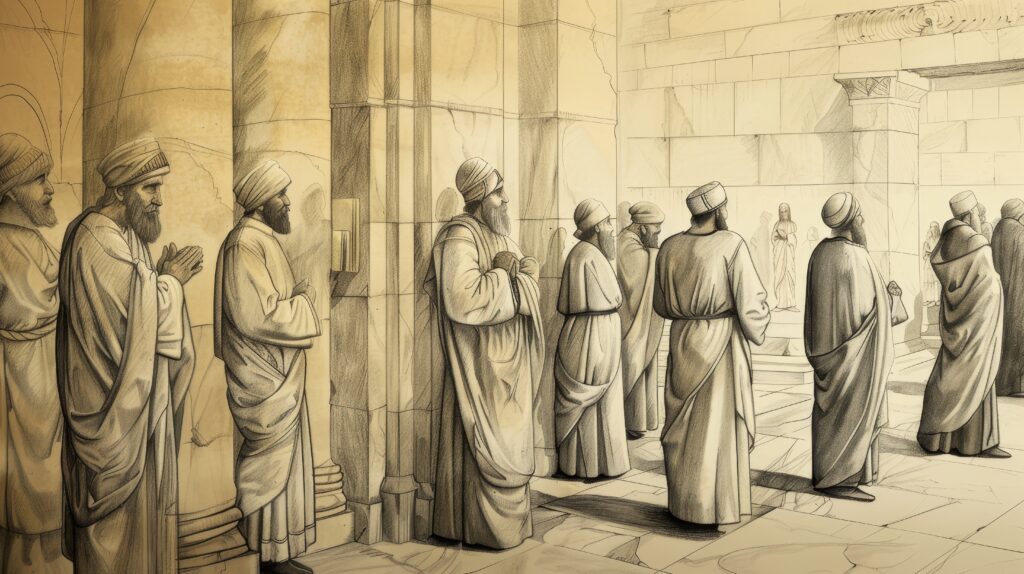
The Pharisees had a lot of popular appeal. They appear to have been composed of a broad cross-section of society. They weren’t priests. Usually they were small landowners, shop-owners, or craftsmen. This gave them more mass appeal and influence with the common people than the wealthier, more elitist Sadducees. Those Pharisees who did have more financial means used their influence to advocate for their understanding of the scriptures in the halls of power. But most used their influence to persuade ordinary Jews of the day to keep the Torah to the best of their ability and maintain ritual purity as faithfully as possible.
Pharisees would frequently be the ones teaching in the synagogue on the Sabbath and educating young Jewish boys during the week. They modeled zeal for the scriptures, pursued holiness in all of life, and sought to maintain priest-level ritual purity in their homes.
In other words, in many of the villages where Jesus taught, the Pharisees were actually the good guys, not the bad guys we make them out to be. So why the tension between them and Jesus? Well before we can answer that, we need to understand two distinctives that set the Pharisees apart.
1. Holiness and Ritual Purity
The Pharisees sought to pursue holiness and ritual purity in all of life. They devoted their attention to the study of the scriptures and aimed to clearly specify what God’s law required. From there, they strove to practice careful exactness in the keeping of God’s Law.
This is what the apostle Paul has in mind when he describes his life as a Pharisee before he met Jesus by saying, “as to the Law, a Pharisee” and “as to the righteousness which is in the Law, found blameless” (Philippians 3:5-6, NASB).
In addition to moral purity, Pharisees also sought to maintain in their own homes in the same ritual purity required of priests in the temple. If it was good for the house of God, then it was good for their house too! So, for example, how their food was prepared and eaten and whom they ate with were matters of profound seriousness. They were fastidious about other matters of ritual purity as well.
At its best, the motivation and goal of all this was to honor God by being holy.
“The Pharisees sought to pursue holiness and ritual purity in all of life.”
2. Scripture and Tradition
Whereas the Sadducees viewed only the five books of Moses as authoritative, the Pharisees believed that the prophets and writings were authoritative as well. These were the scriptures which taught God’s ways for them as God’s covenant people.
In addition to submitting to the full collection of Scripture, the Pharisees also had a large body of oral traditions which specified how to faithfully keep the scriptures. Tradition passed on the proper interpretation and application of God’s law. The Pharisees gave their traditions binding authority as well. This was the oral law.
One way the Pharisees portrayed this body of tradition was that it was like building a fence around the Law. For example, the Law instructed the Jews to do no work on the Sabbath. Well, what constitutes work? The traditions specified what counted as work and what didn’t and thereby built a fence around that law so that if you didn’t violate the traditions, you wouldn’t violate the command.
For all 613 commands in the Torah, the Pharisees had traditions that had been passed down from their Pharisaic forefathers which provided a fence to keep them from violating the Torah itself.
To the Pharisees, Scripture plus oral tradition was authoritative and binding, teaching how to be faithful to God’s covenant and God’s law.
“To the Pharisees, Scripture plus oral tradition was authoritative and binding.”
Were the Pharisees legalists?
So, were they legalists?
Well, that depends on what someone means by “legalist.”
Some Christians I have talked with over the years apply the label “legalist” to anyone who is serious about obeying God and being holy…and they mean it in a derogatory sense! When someone uses the label “legalist” in this way, it is almost always a self-justification for their own lackadaisical approach to holiness. In this sense, the Pharisees were indeed “legalists” because as a whole they aimed to take holiness and obedience seriously, which is actually noble and right.
But more often by using the term “legalist,” we are referring to someone who believes that their obedience merits God’s favor, a person who thinks they have to and perhaps can earn God’s grace by their good works. Unfortunately, many Christians suppose that the laws in the Old Testament were like that—a bunch of rules the Jews had to keep in order to earn God’s grace. So many assume that this was the objective of the Pharisees and this is why Jesus criticized them so sternly.
However, in the history of Israel, God’s Law followed God’s redemption for Israel. That is, God saved them out of Egypt before he instructed them through his Law. Grace preceded obedience even for Israel under the old covenant.
So generally speaking, the Pharisees did not believe that their obedience earned God’s grace. That’s not to say that some may not have slipped into such a pattern of thinking and acting. Overall, however, they had their theology straight on this.
But correct theology doesn’t always lead to correct practice.
And that seems to be where Jesus took issue with the Pharisees he criticized.
“Some Christians I have talked with over the years apply the label ‘legalist’ to anyone who is serious about obeying God and being holy.”
Why the conflict with Jesus? 
Jesus commends the teaching of the Pharisees but not their practice. He says, “The scribes and the Pharisees have seated themselves in the chair of Moses.” That is, they teach the Law of Moses well and accurately, which is why theologically Jesus is very similar to the Pharisees. “Therefore,” Jesus continues, “whatever they tell you, do and comply with it all, but do not do as they do; for they say things and do not do them” (Matthew 23:2-3, NASB). In other words, what they teach is good; do it. But don’t follow their example because they don’t practice what they preach.
Immediately after saying this, Jesus pronounces eight woes on the Pharisees in which he labels them blind guides and hypocrites. And at the heart of his critique is the fact that they look good on the outside but aren’t clean on the inside (see Matthew 23:25-27). In other words, Jesus wants them to be more holy, not less. For all their quest after holiness, according to Jesus they aren’t holy enough because their holiness is only skin deep; it hasn’t penetrated to the depths of their inner being. In Jesus’ words, “So you too, outwardly appear righteous to people, but inwardly you are full of hypocrisy and lawlessness” (Matthew 23:28, NASB)
This is one of Jesus’ major complaints against some of the Pharisees he encountered. It’s instructive to us because it indicates that Jesus intends for his followers to be deeply holy from the inside out. In fact, the main point of Jesus’ Sermon on the Mount is that our righteousness needs to surpass that of the scribes and Pharisees (Matthew 5:20).
“Jesus commends the teaching of the Pharisees but not their practice.”
His other issue with the Pharisees was with the way they misused their traditions. One incident where this shows up is recounted in Matthew 15:6. There, Jesus challenges a specific tradition by which he says they set aside the clear command of God’s law. In another encounter, Jesus is angered and grieved by a tradition about what constitutes work on the Sabbath (Mark 3:1-6). The issue is two-fold: they give their traditions the same weight as God’s commands and in practice their traditions sometimes actually take precedence over God’s commands.
Once again, this is instructive for us. Whenever we make our suggested applications of God’s word just as authoritative and binding as God’s Word, we too are guilty of teaching as doctrine the commandments of men (Matthew 15:9).
For example, I once knew someone who taught emphatically that if a couple was going to have a godly marriage, they must have a weekly date night. In his mind, this was a necessary application of Ephesians 5:22-33, and he could make married couples feel like they were failing to obey God if they didn’t do this. But this is the same mistake the Pharisees made. Suggested applications don’t have the same weight as biblical principles.
“Suggested applications don’t have the same weight as biblical principles.”
So the irony is, Jesus was calling the Pharisees to account on the basis of two of their most prized core values: holiness and faithfulness to Scripture. Those values in and of themselves are good, and Jesus wanted them (and us) to live them out more deeply and more faithfully. But to do that will require profound change, a change that has Jesus at its heart. As the former Pharisee the apostle Paul puts it:
“But whatever things were gain to me, these things I have counted as loss because of Christ. More than that, I count all things to be loss in view of the surpassing value of knowing Christ Jesus my Lord, for whom I have suffered the loss of all things, and count them mere rubbish, so that I may gain Christ, and may be found in Him, not having a righteousness of my own derived from the Law, but that which is through faith in Christ, the righteousness which comes from God on the basis of faith.” (Philippians 3:7-9 NASB)
Only a total reorientation of our life around Christ, one where he himself becomes the supreme value and knowing him the grand quest, has the power to make a Pharisee into the apostle to the Gentiles and make us into the kind of people God created us to be—righteous, holy, and faithful from the inside out.
Meet more of the people of the Bible, from Eve to the apostles.