


What are angels in the Bible? Starting out, it’s helpful to clarify that the original words often translated as angel do not always refer to supernatural, angelic beings. The Hebrew (mal’āḵ) and Greek (angelos) words for angel appear 214 and 186 times, respectively, across the Old and New Testaments. These uses primarily serve to describe angelic messengers for God or manifestations of God’s will. Yet not all uses of these words imply supernatural beings; sometimes, often even in the Old Testament, the word is simply used to refer to a human messenger, an ambassador (Genesis 32:3, Luke 7:24).
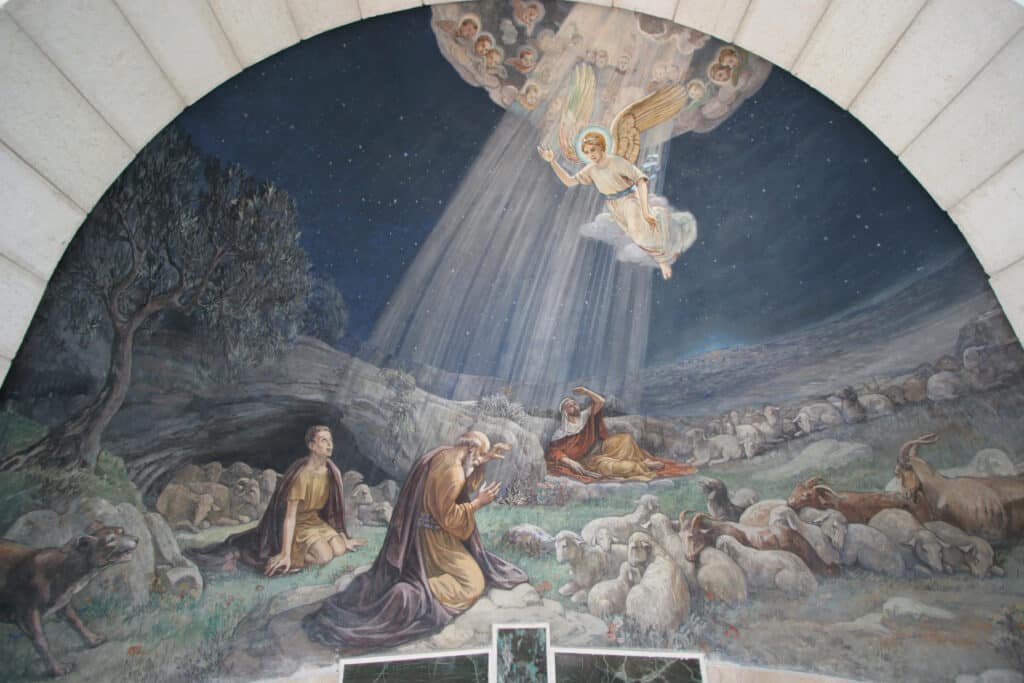
As it pertains to the supernatural beings though, the Hebrew word appears in accounts like Jacob’s ladder (Genesis 28), the Psalms, and throughout the Major and Minor Prophets. Some well-known uses of the Greek word include Gabriel’s appearance to Mary in Luke 1 and then the subsequent appearance of an angel and the “heavenly host” before the shepherds of Bethlehem in Luke 2. These beings’ presence spans the entirety of Scripture, and their participation in the biblical narrative implies a divine and purposeful inclusion in humanity’s reconciliation to God and the redemption of all creation.
But who or what exactly are angels?
Scattered throughout the 300-plus uses are tidbits about their character, traits, and roles. Beginning with the Old Testament, angels are
- able to communicate/interact with people (Genesis 16:9, 19:1),
- sent to guide/protect/prepare/hinder people (Genesis 24:7, Exodus 23:20, Numbers 22:22),
- unseen but still acting at times (Numbers 22:31),
- terrifying to behold (Judges 13:6),
- thought to be discerning/wise (2 Samuel 14:17, 20),
- capable of destroying people/places but under the authority of God (2 Samuel 24:16, 17), and
- vulnerable to error/folly (Job 4:18).

“Angels’ participation in the biblical narrative implies a divine and purposeful inclusion in humanity’s reconciliation to God and the redemption of all creation.”
Additionally, angels in the New Testament are
- able to take care of physical/spiritual needs (Matthew 4:11),
- divine enforcers (Matthew 13:41),
- watching over people, especially children (Matthew 18:10),
- capable of being in the presence of God (Matthew 18:10),
- unmarried (Matthew 22:30),
- vulnerable to judgment (Matthew 25:41),
- numerous (Matthew 26:53),
- able to interact with the physical world (Matthew 28:5),
- of bright/unearthly appearance (Acts 6:15),
- capable of appearing human (Hebrews 13:2),
- capable of emotional responses (1 Peter 1:12),
- of noteworthy power/strength (2 Peter 2:11), and
- sometimes associated with certain places or people (Revelation 2:1).
While the above isn’t an exhaustive list of angelic characteristics or traits, many others might be inferences from the texts. Are they immortal? Are they all named? Do they have wings? I don’t know, but what is clear from the text is a servant-based but also free-willed relationship with God. They seem to operate and largely exist outside of a realm that we can presently perceive, but their service overlaps with the human experience in personal and impactful ways.
“They seem to operate and largely exist outside of a realm that we can presently perceive, but their service overlaps with the human experience in personal and impactful ways.”
Paul’s declaration that “Christians will judge angels” (1 Corinthians 6:3) and the assertion in Hebrews 13:2 that people have unwittingly hosted angels in their homes and, thus, ought to be gracious in our hospitality both imply a shared accountability for human and angelic actions, in regard to both God and one another. We are both created, subservient, and relational beings who are subject to God’s will and judgment.
Archangels
Another linguistic item of note is the presence of the Greek word archangelos, which is often translated as “archangel.” The term is used only twice. The first use is in Jude 1:9 where it refers to “Michael, one of the mightiest of the angels” (NLT), contending with Satan for the body of Moses. The second is in 1 Thessalonians 4:26 when, at “the call of the archangel, and with the trumpet call of God,” “the Lord himself will come down from heaven” (NLT).
The presence of this term implies a hierarchy among the angels, or at least a singular distinction for one among them. Michael (Hebrew mîḵā’ēl, Greek michaēl) appears by name just three times in Scripture and is in warring conflict each time (Daniel 10/12, Jude 1, Revelation 12) where he commands the other angels. He also stands in defense of the nation of Israel in Daniel’s vision.