

I was blessed to discover the riches of reading the Bible around the age of 16, and although I cannot directly recall the first time I read that footnote to John 7:53-8:11, I remember it rattled me a bit and that it’s surfaced in my thoughts throughout the past three decades of my adult life.
You know the footnote I’m talking about? This is from the NASB (2003) regarding John 7:53:
“Later manuscripts add the story of the adulterous woman, numbering it as John 7:53-8:11.”
Or this one in the NIV (2023):
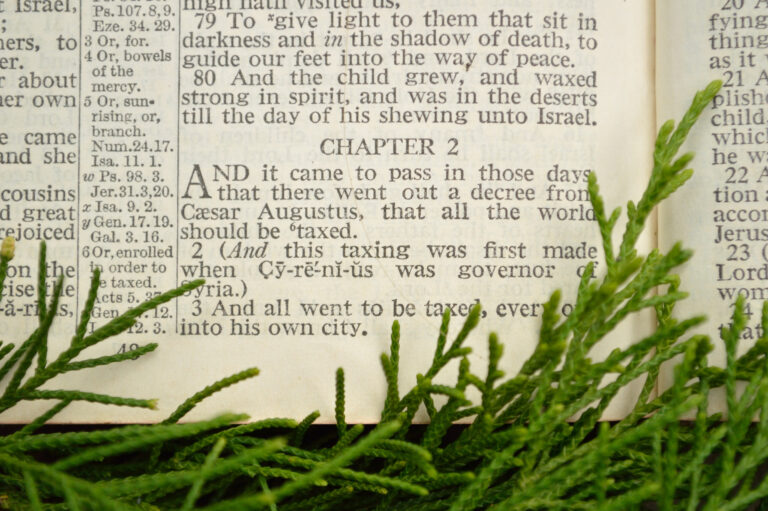
“The earliest manuscripts and many other ancient witnesses do not have John 7:53-8:11. A few manuscripts include these verses, wholly or in part, after John 7:36, John 21:25, Luke 21:38 or Luke 24:53.”
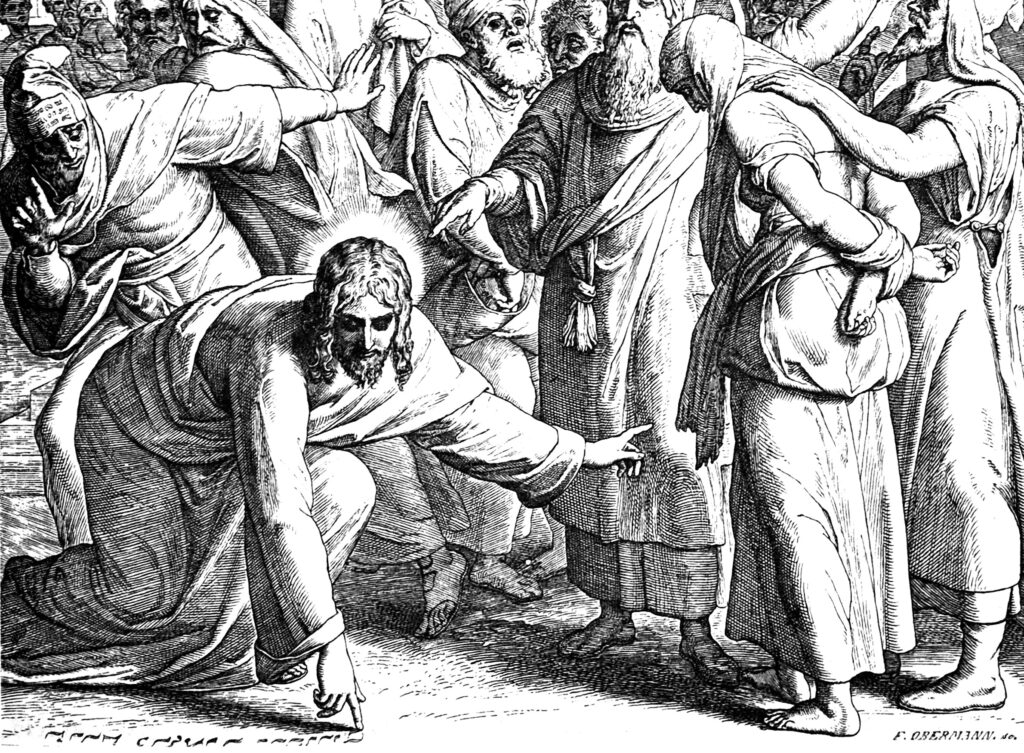
What? This beloved story of Jesus writing in the sand and turning the mob away from their vengeance against this adulterous woman—it might not have been in the original Gospel of John? And when it does show up, sometimes it’s in the middle of John or at the end of John or even in the Gospel of Luke? Who knew a little footnote could be so jarring?
“Who knew a little footnote could be so jarring?”
While I appreciate both the honesty and additional clarification of the translators, I admit that this realization concerned me early as a young Christian. Were those responsible for putting together and printing our Bibles questioning the veracity of this passage? Does this mean there are other such passages that come into question? How am I to trust this text and teach this story if we’re not certain how or if it appeared in the original?
Along the way, I learned helpful answers to my questions. I learned that, yes, those responsible for putting together and printing our Bible represent thousands of scholars across time and geography. These scholars rigorously engage in the science of “textual criticism,” where they survey an embarrassing wealth of ancient manuscripts to work from. In fact, they have nearly 6,000 ancient Greek New Testament manuscripts and thousands of Hebrew Old Testament manuscripts and fragments to work from, including the Dead Sea Scrolls which provide some 220 ancient biblical manuscripts predating Jesus, most of which are in Hebrew. Altogether, these manuscripts provide—as textual critic Dan Wallace calls it—an “embarrassment of riches” from which scholars draw, making the Bible the most well-attested book of human history.
I learned that while there are numerous textual questions (“Does the original say A or does it say B?”), the overwhelming majority of these textual variants don’t affect the actual meaning of the text. To be sure, there are some textual variants that do affect the meaning of the text, with the biggest two questions in the New Testament being about this passage in the Gospel of John and the other being about the ending of the Gospel of Mark—whether the Gospel of Mark ends at verse 8 or keeps going.
“I learned that while there are numerous textual questions, the overwhelming majority of these textual variants don’t affect the actual meaning of the text.”
And when I kept digging into this question about the story of the adulterous woman, I learned a good possible explanation from a book by James Snapp, Jr., called A Fresh Analysis of John 7:53-8:11. In his book, Snapp offers what he sees as a better explanation than that someone randomly inserted this story into the Gospel of John. Snapp reminds us that churches regularly used readings from the scriptures in their church services. These readings are organized into what we call “lectionaries.” This passage about the adulterous woman falls right in the middle of a lectionary reading—it comes between two passages that were read together annually at Pentecost.
Snapp argues that it’s less likely that a scribe randomly inserted this story in the middle of a lectionary reading—and more likely that the story was originally in the Gospel of John but was skipped over for the lectionary reading. The idea is that one copyist of the Gospel of John, using a lectionary copy as a reference, misread the lectionary instructions to skip the story of the adulterous woman. The instructions were intended only to affect the lectionary reading—to skip the story for the public reading in church—yet the overzealous copyist misread the instructions and skipped the section entirely as he was copying the Gospel of John. That copy went on to survive and influence later copies.
“Snapp argues that it’s less likely that a scribe randomly inserted this story in the middle of a lectionary reading—and more likely that the story was originally in the Gospel of John but was skipped over for the lectionary reading.”
One interesting fact is that the copies that omit this story predominantly cluster in the region surrounding Alexandria, Egypt, where there was a major copying center for the scriptures. As papyri were better suited to survive in the desert air of Egypt, it was these copies that survive into our day as the oldest existing manuscripts. This wouldn’t mean that this was necessarily the earliest family of manuscripts, just that they were the earliest ones to survive into modern times. Hence, the footnote in our Bibles which says that this passage is not found in our earliest surviving manuscripts. I personally find Snapp’s explanation helpful.
So, for what it’s worth, regarding this text, I embrace it as a true story, although I’m optimistically uncertain whether or not it was original to John’s written Gospel. And again, I find Snapp’s scenario plausible, namely, that the confusion started when they began skipping over the story in church lectionaries. So, I’m personally okay with teaching and preaching this story, even as I think it can be helpful to let people know about the uncertainties surrounding it, and therefore I appreciate the honest attitude behind such brief footnotes in most modern Bibles.
But here’s where I would like to take a step back and ask a bigger question: Do Christians have reason to be embarrassed by questions like these? Should we feel sheepish because we aren’t exactly sure what to do with the story of the adulterous woman or with the extended ending of Mark? Or because we have so many textual variants between different copies of Scripture?
“Do Christians have reason to be embarrassed by questions like these?”
By contrast, Muslims can boast having only one standard version of the Koran. Of course, this was because a 7th-century Muslim leader, Caliph Uthman, established the standard text in part by destroying other copies of the Qur’an that contained textual variants. But compared to Islam, does it put Christians at a disadvantage not to have one standard version, but rather many families of manuscripts that come with unresolved questions about textual variants?
Here is where I want to return to a phrase I mentioned earlier by textual critic Dan Wallace. Wallace says that, indeed, Christians have an embarrassment—but it’s an “embarrassment of riches.” We are sheepish only because we have been given far more than others can boast. So, what kinds of riches do we have as Christians? 
Well, for one thing, we do not have only one man receiving divine revelations in a cave from an angel, as in Muhammad with the Quran. We do not have only one Joseph Smith, as in the Church of Jesus Christ of Latter-Day Saints, receiving from an angel golden tablets that became the Book of Mormon. Rather, we have many eyewitnesses writing what they saw Jesus say and do. Does that mean that sometimes we have to discern why this eyewitness says something that sounds different from what that eyewitness says? Yes, but none of those differences are insurmountable, and again, compared to Islam and the LDS Church, we have riches in the form of multiple witnesses to Jesus’ life and teachings.
“We have riches in the form of multiple witnesses to Jesus’ life and teachings.”
We also have an embarrassment of riches when it comes to the number of hand-written copies of the New Testament—nearly 6,000 manuscripts in the Greek language alone. Does that mean that, with all those manuscripts, sometimes we have to puzzle over which manuscript represents the original and which manuscript represents a later variant? Yes, but if you look at those variants, even the ones which could affect the meaning of a text, you will see that none of those variants could fundamentally change who Jesus is or what the gospel teaches.
We have riches when it comes to the thousands of manuscripts from multiple regions—an overabundance of manuscripts which gives us confidence that scholars are able to reconstruct what was originally written. We have no reason to be sheepish about textual variants when so much intellectual strength lies in our openness and honesty about the richness of manuscripts to which we are heirs.
And the riches continue to multiply as the Christian faith expands outward into innumerable cultures and languages. Does Christianity’s cultural and ethnic diversity mean tough questions and practical dilemmas? Yes, and more with each passing day. Christians can’t rest in having a single sacred language, as in Islam’s view of Arabic, or in being rooted to a single cultural heritage, as in Hinduism’s rootedness in the Indian subcontinent.
“We have no reason to be sheepish about textual variants when so much intellectual strength lies in our openness and honesty about the richness of manuscripts to which we are heirs.”
In the Christian view, people from “every nation, tribe, people and language” retain unique cultural identities even in heaven (see Revelation 7:9). In the meantime, that means messiness as Jesus draws both soldier and pacifist, liberal and conservative, activist and quietist, rich and poor, Jew and Gentile, Westerner and Easterner—all captivated by the single unparalleled life of Jesus.
It is this Jesus that inspired multiple eyewitnesses to write dozens of documents copied thousands of times into thousands of languages and translated into thousands of cultures.
So, whether you find more in common with the adulterous woman or the judgmental Pharisee, you, yes you, are invited to pause and consider this incomparable Jesus. Yes, we often find ourselves embarrassed, usually by our own sin and unworthiness. But even that embarrassment is swallowed up in gratitude for the riches of knowing Jesus.