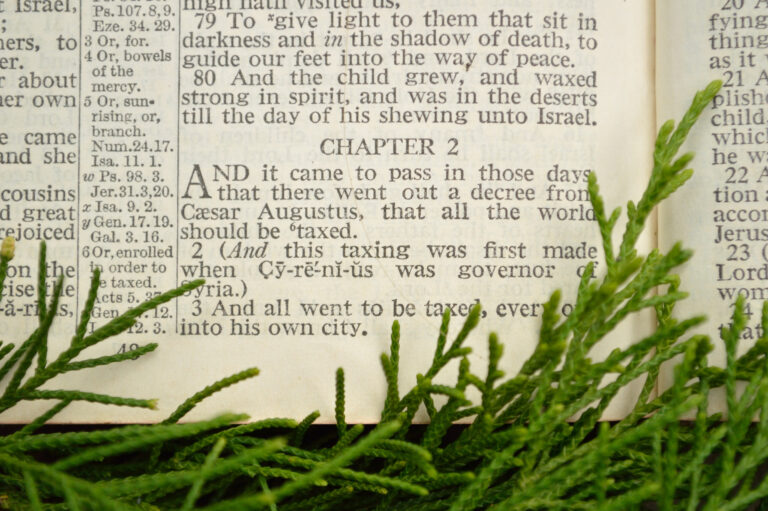



The New Testament begins very Jewishly. After listing Jesus’ Jewish genealogy going back to Abraham himself, Matthew explains how Jesus’ birth fulfills what the Jewish prophet Isaiah had prophesied long before in the Jewish Bible. That’s Matthew chapter 1.
But then comes chapter 2. Into this kosher story intrude strange Gentiles with their Gentile ways. Verse 1 has “Magi from the east” coming to find Jesus (“Magi” being the root word for “magic” and “magician”). How did they get invited to the story? Apparently part-dignitary, part-astrologer, these eastern Magi, likely Persian, followed a “star” that led them to Judea and right into the covetous confidences of King Herod, whom they told about the young king they had arrived to worship.
The “star” apparently got them to Judea, Israel’s southern region. In Judea’s capital city, they asked where the new child-king was. Suddenly interested in finding this young king, King Herod consulted with his religious advisers, who told them of Micah’s ancient prophecy that the Messiah would be born in Bethlehem, only a handful of miles south of Jerusalem.
“The ‘star’ apparently got them to Judea, Israel’s southern region.”
So, Herod called in the Magi, learned from them when the star had appeared, and sent them to find the child in Bethlehem and report back to him. It’s at this point that the “star” reappears in the story. It “went ahead of them until it stopped over the place where the child was” (Matthew 2:9, NIV). It guided them to the house where the child lived with his parents. They went in, presented gifts, and bowed before Jesus, worshiping him.
Cool story. Strange star though! A star that apparently moves—and comes to rest over a house? And…finding God through astrological signs? Seems out of place. Out of order too, since Jesus’ gospel wasn’t going to reach Gentiles until after Jesus would grow up, die, and rise. Rather than late to the party (as the Magi showed up months or even years after Jesus’ birth), the Magi seem almost early—as the Jesus movement didn’t become a Gentile thing until decades later.
So, what was the star? Short answer: We don’t really know. But we do have a few puzzle pieces—certainly not as many as we’d like—that can help us get a fragmentary picture of what the celestial sighting might have been and what group would have picked up on it. Here are the main puzzle pieces—historic, astronomical, etc.—that we do have:
Puzzle Piece #1 – Celestial Conjunctions
Let’s start with what might have been visible in the sky around the time of Jesus’ birth. In terms of celestial phenomena, there could be comets (icy combinations of dust, rock, and gas that orbit a star), novas (minor explosions that make a star brighter), supernovas (massive explosions that often destroy a star), and planetary conjunctions (e.g., when two celestial bodies “come together” and thus appear more brightly).
A helpful article on Space.com[1] basically rules out comets, novas, and supernovas as being the “star of Bethlehem.” Even though Halley’s Comet was visible in 11 B.C. (likely too early for Jesus’ birth), comets alter position as Earth rotates and would thus have been difficult to meaningfully follow. Plus, comets were considered bad omens. As for novas and supernovas, they are stars, and even though they stay fixed in the sky, from Earth’s perspective, they “rise” and “set” and as with comets it wouldn’t work to “follow” them. Plus, if any novas or supernovas were visible from Earth around the time of Jesus’ birth, no historians back then noted it and no astronomer today has seen physical debris left behind by it.
“In terms of celestial phenomena, there could be comets, novas, supernovas, and planetary conjunctions.”
A more likely candidate is a conjunction—a bringing together—of objects in the sky, at least from the viewer’s perspective. If, say, a star and a planet “came together” around the same time each night, that could give someone a specific direction to travel over many days (i.e., someone could follow the approximately same-time-of-day fixed point of a planetary conjunction to a specific region). For example, it has been calculated that there was a rare “triple conjunction” (two objects appearing to pass each other three times in a short period) of Saturn and Jupiter in 7 B.C., followed by a much rarer “massing” (a clustering together of three or more objects) of Mars, Jupiter, and Saturn in 6 B.C.[2] With the Magi preoccupation with astrology, it was perhaps significant to them which constellation these occurred in, with the 6 B.C. triple conjunction taking place in the constellation Pisces and the 7 B.C. massing in the constellation Aries.
Puzzle Piece #2 – A Global Dispersion of Judaism
Although the ancient Jews settled a strip of land today’s maps call “Israel,” by the time Jesus was born, there were more Jews living outside their historic homeland than living in it. The northern tribes of Israel had been conquered by Assyria (8th century B.C.), and the southern tribes had been conquered by Babylon (6th century B.C.), an empire which was subsequently conquered by Persia. When conquered, large populations of Jews went into exile, and only some returned home when the Persians permitted the return. Babylon, Parthia, Asia Minor, Arabia, Egypt—many places outside Israel held huge numbers of Jewish “diaspora” (dispersion) by the time of Jesus.
Pertinent to the story of the Magi is that, while we’re told only that they’re from the “east,” the Magi are usually connected more specifically with the historic land of Persia—an eastern area called “Iran” nowadays but called “Parthia” during the time of Jesus. Old Testament books such as Daniel and Esther suggest there were large numbers of Jews in Persia at their time, and the same was still true when the area was later ruled by the Parthians.
“Old Testament books such as Daniel and Esther suggest there were large numbers of Jews in Persia at their time, and the same was still true when the area was later ruled by the Parthians.”
Another possibility that has been proposed is that, instead of being Parthians, the Magi were part of the Nabatean Kingdom—the region east of Jerusalem, encompassing parts of Syria, Jordan, the Sinai, and Arabia.[3] Whether the Magi were Parthian or Nabatean, the point is that, with large populations of Jews in Parthia and Nabataea would come familiarity with Jewish heritage and religion—and along with that the anticipation of a messianic king.
Puzzle Piece #3 – A Comparable Visitation
You can judge how helpful of a comparison this is, but we have a record of another visit by eastern Magi to pay homage to a western king. It was the year A.D. 66. The Parthians and Romans had been at war over Armenia, the region that lay between them. As part of the treaty to end the war, Armenia would be ruled by a Parthian—but he would have to be approved by the Roman emperor.
Thus, King Tiridates of Armenia, a Parthian, traveled west to Rome to Emperor Nero to pay Nero homage and receive the crown from him. The historian Pliny the Elder calls King Tiridates a “magian” (member of the Magi) and tells us he was accompanied in his trip by an entourage of Magi.[4] Although contrasts outnumber comparisons here with the story of Magi in Matthew, it is noteworthy that eastern Magi sometimes undertook long diplomatic trips to pay homage to kings from other nations. 
Puzzle Piece #4 – A Rumor in the East
We are also told of a rumor in the East that a ruler would arise from Judea (the southern region of Israel). Both Tacitus and Seutonius, ancient Roman historians, mention this belief, with Suetonius writing, “A firm persuasion had long prevailed through all the East, that it was fated for the empire of the world, at that time, to devolve on some one who should go forth from Judea.”[5]
When Vespasian rose to prominence in Judea by crushing the Jewish revolt (A.D. 66-70) and then becoming Roman emperor, it was easy for Roman loyalists, including Jewish historian Josephus, to apply this prevailing belief to Vespasian: he was the one who went forth from Judea to rule the world. But at the time of Jesus’ birth, this rumor might very well have played a part in the visit of the Magi to travel to Judea to worship the new king.
“A firm persuasion had long prevailed through all the East, that it was fated for the empire of the world, at that time, to devolve on some one who should go forth from Judea.”
Puzzle Piece #5 – A Spiritual World
It’s indeed interesting that the “star” which led the Magi to Judea’s capital city—where they then had to stop to get further direction—somehow resumed guiding them all the way to the house where Jesus lived. Even if a conjunction of planets led someone to a region like Judea, something more would be needed to explain how a celestial body could direct the way to a house. Here, it’s worth mentioning that the Bible often makes a connection between stars and angels. For example:
“…The morning stars sang together and all the angels shouted for joy…” (Job 38:7, NIV)
“[The horn] grew until it reached the host of the heavens, and it threw some of the starry host down to the earth and trampled on them.” (Daniel 8:10, NIV)
“The seven stars are the angels of the seven churches…” (Revelation 1:20, NIV)
As Michael Wilkins helpfully points out in his NIV Application Commentary on Matthew, angels already factor prominently in the birth story in Matthew—announcing the Messiah’s coming to Joseph (Matthew 1:20), warning Joseph to flee Herod’s intentions (Matthew 2:13), and welcoming Joseph to return (Matthew 2:19-20). Angels were also involved in guiding the Israelites to the Promised Land:
“See, I am sending an angel ahead of you to guard you along the way and to bring you to the place I have prepared.” (Exodus 23:20, NIV)
“The Bible often makes a connection between stars and angels.”
A connection between the star and an angel is mentioned as early as the apocryphal 6th-century Arabic Infancy Gospel. Though this is likely little better than speculation, it does suggest that the angel-star connection was seen as plausible by some in the centuries following Jesus’ birth. According to the Arabic Infancy Gospel,
“And in the same hour there appeared to them [the Magi] an angel in the form of that star which had before guided them on their journey; and they went away, following the guidance of its light, until they arrived in their own country.”[6]
Puzzle Piece #6 – A God in Pursuit
In his words, Jesus came to “seek and save the lost” (Luke 19:10, NIV). Praise God he doesn’t wait for us to stumble our way through the dark to him. As someone who pursues the lost, it’s within God’s wheelhouse to use the shiny objects of a lost person’s world—objects he himself created—to lead the lost to Jesus, “the true light that gives light to everyone” (John 1:9, NIV).
“Every good and perfect gift is from above, coming down from the Father of the heavenly lights, who does not change like shifting shadows.” (James 1:17, NIV)
[1] Jonathan O’Callaghan, “What Was the Star of Bethlehem?” Space.com, December 22, 2024, https://www.space.com/star-of-bethlehem.
[2] Both were calculated by Johannes Kepler in the 1600s. See John Mosley, “Common Errors in ‘Star of Bethlehem’ Planetarium Shows,” International Planetarium Society, 1981, https://www.ips-planetarium.org/page/a_mosley1981.
[3] Bryan Windle, “Who Were the Magi?” Bible Archaeology Report, December 22, 2022, https://biblearchaeologyreport.com/2022/12/22/who-were-the-magi/.
[4] See Chapter 6, Book 30 of Pliny the Elder, The Natural History, https://www.perseus.tufts.edu/hopper/text?doc=Perseus:text:1999.02.0137:book=30.
[5] See Suetonius Tranquillus, Divus Vespasianus, chapter 4, https://www.perseus.tufts.edu/hopper/text?doc=Perseus%3Atext%3A1999.02.0132%3Alife%3Dves.%3Achapter%3D4#note-link3.
[6] The Arabic Gospel of the Infancy of the Saviour, New Advent, https://www.newadvent.org/fathers/0806.htm.
This article is part of a larger collection. Find 45+ Christmas articles, studies, and reflections.