
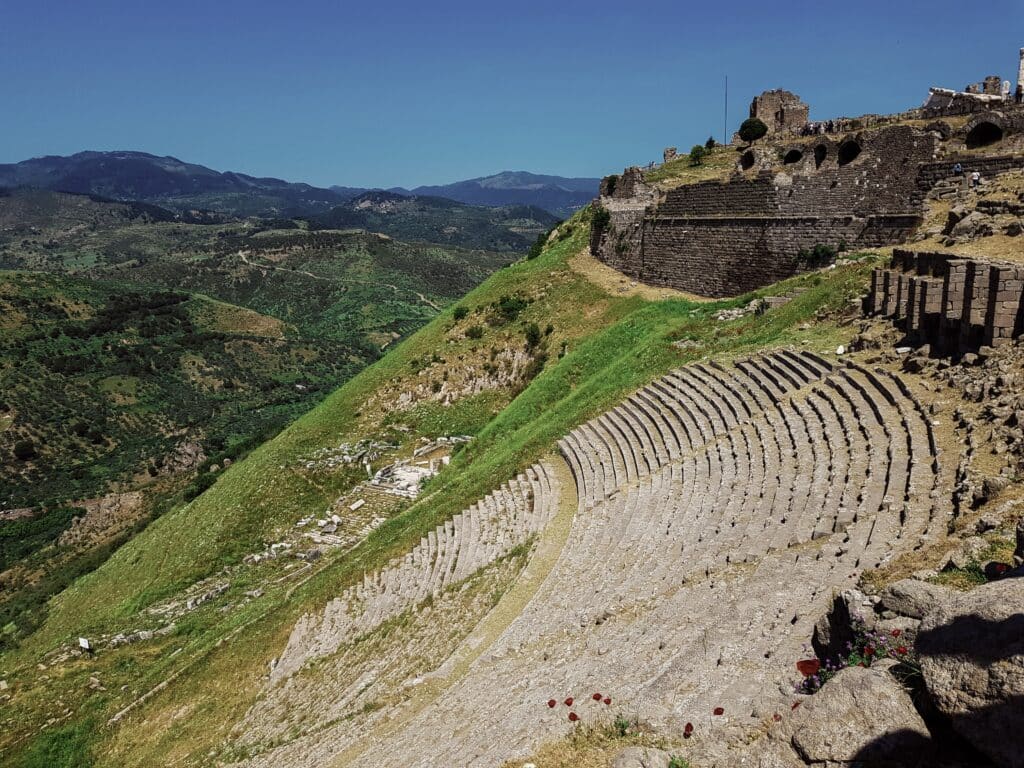

Going on the road north from Smyrna you would travel along the coast for 40 miles, then you’d go northeast up the valley. Ten miles east from the shore was the Roman capital of Asia, Pergamum. The city had a special relationship with Rome having been longtime allies, making it a natural pick to hold the throne of Rome’s rule in the province. It likewise had a population larger than most modern cities. Parchment was invented in Pergamum. They had a library that rivaled Alexandria’s. There are still a good bit of ruins from the city where it once stood.
Built on a cone-shaped hill 1000 feet high, Pergamum was especially noticeable and dominated the eyesight of everyone who would have seen it. At the top of the hill was a great altar to Zeus/Jupiter. “Jupiter” is merely what the Romans called the god which the Greeks called “Zeus.” What you may not know is that Zeus is merely what the Greeks called the Phoenician (a nation bordering Israel) god “Baal.” This great altar of Jupiter/Zeus/Baal being on top of the hill made it so that for anyone approaching the city, the entire citadel, the whole mountain, would look like a giant throne of Zeus.
This darkness underscores the incredible nature of Jesus’ message to the churches—which is not to leave these cities, but to be in them, to witness and be a light to them.
“This darkness underscores the incredible nature of Jesus’ message to the churches—which is not to leave these cities, but to be in them, to witness and be a light to them.”
Pergamum was a great center of pagan worship beyond Zeus, being a major center of cults for Athena, Dionysus, and Asklepios. Because Zeus was so important and the head of the Greek/Roman/Phoenician pantheon, it was a great statement for his major temple and altar to be at the top of the hill of Pergamum, the city which was the head, or “throne,” of Roman rule in Asia.
Intertwining the Spiritual and Material
In the ancient world, there was absolutely no separation between what we would consider the “spiritual” world and the “natural” or “material” world. The gods were seen as deeply and fundamentally intertwined with 100% of every aspect of life.
Especially important about Pergamum was that it was the seat of Roman rule and the center of the imperial cult in the Roman province of Asia Minor. When I talk about cults in the ancient world, the meaning is not what a modern cult is. The modern cult is like an abusive relationship. They love you; then once you join, they show their true colors. They’re dominating. They abuse and guilt and shame you and want to control you. They spring you with their real beliefs.
But that is not the ancient definition. Religion in the ancient world was typically not about beliefs, which was in the realm of philosophy. Religions were about rituals for the gods. Religion also was not separated from any part of life, but everything was intertwined with the pagan gods. You were expected to do some ritual to pay respect to the gods of whatever you did, or wherever you were.
Any group, despite what it was dedicated to, had religious matters. The ancient definition of a cult is a group solely dedicated to religious matters. So, an example is those who worked at the temples would be known as the temple cult. The imperial cult, simplified, was the entity dedicated to making sure emperors and the empire were properly worshipped and to ensure everyone gave them proper due.
“The gods were seen as deeply and fundamentally intertwined with 100% of every aspect of life.”
Punished for Resisting
Ruins have been uncovered in Pergamum of altars in the backs of houses, showing physical remnants of the events of festivals in the city. When the festival passed by your house, it was expected for each household to offer a sacrifice to the gods. Beyond being an opportunity to party, the city called for worship in these festivals to bring blessings from the gods and the emperors being worshipped. The seriousness was displayed by the fact that they killed Christians for not joining. We also know very early accounts from not long at all after Revelation of Christian stonecutters in Pergamum put to death for refusing to build idols of emperors.
While all the churches endured varying degrees of tribulation and persecution, Pergamum was the only city so far in these seven in which a Christian had been martyred, a faithful witness named Antipas. It was a very cruel martyrdom, as most were. Romans were masters of torture. Most civilizations were incredibly more violent and cruel in the ancient world than we in the modern world can imagine. However, the Romans had an unparalleled lust for blood and were sadistic and cruel in a way that even greatly shocked the rest of the ancient world.
According to the account, a temple sex slave came to Antipas as he had been witnessing about Jesus, and Antipas cast out the demons from her. This was a disruption for the city’s important cultic life. It was considered an offense to the gods, and it was seen as not his place, for she was considered someone else’s property.
“Pergamum was the only city so far in these seven in which a Christian had been martyred, a faithful witness named Antipas.”
For this, Antipas was put in a bronze bull. A bronze bull is a bronze statue of a bull hollowed out inside and put over a fire. The one punished would be put inside of it and would roast alive. It was designed so that when they screamed it would sound from the outside like a cow mooing.
The Roman tortures and punishments inflicted on Christians were horrifically violent, but these punishments were also meant to make a mockery of their victims. Those punished were stripped down naked to make it as humiliating as possible, or dressed in mocking costumes. The most well-known example is the Romans putting Jesus in the purple robe and crown of thorns. Roman punishments were done in public, in the public areas, and were entertainment for the crowds.
The Message to the Church in Pergamum
Before quoting Jesus’ message to the church in Pergamum, for context I’m going to put a few verses here about the Old Testament figure Balaam. As referenced in my article on Smyrna, Balaam gave a true prophecy of blessing, but at some point, turned and helped the Canaanite kings. In a clever move, he advised the Canaanite kings that, although they couldn’t defeat Israel because of their God, if they could entice Israel into sexual sin and worship of their gods, the God of Israel Himself would destroy them.
“While Israel was staying in Shittim, the men began to indulge in sexual immorality with Moabite women, who invited them to the sacrifices to their gods. The people ate the sacrificial meal and bowed down before these gods. So Israel yoked themselves to the Baal of Peor. And the Lord’s anger burned against them. The Lord said to Moses, ‘Take all the leaders of these people, kill them and expose them in broad daylight before the Lord, so that the Lord’s fierce anger may turn away from Israel.’ So Moses said to Israel’s judges, ‘Each of you must put to death those of your people who have yoked themselves to the Baal of Peor.’” (Numbers 25:1-5, NIV)
“They fought against Midian, as the Lord commanded Moses, and killed every man. Among their victims were Evi, Rekem, Zur, Hur and Reba—the five kings of Midian. They also killed Balaam son of Beor with the sword.…They were the ones who followed Balaam’s advice and enticed the Israelites to be unfaithful to the Lord in the Peor incident, so that a plague struck the Lord’s people.” (Numbers 31:7-8, 16, NIV)
“They were the ones who followed Balaam’s advice and enticed the Israelites to be unfaithful to the Lord.”
Here is Jesus’ message to the church in Pergamum:
“And to the angel of the church in Pergamum write: ‘The words of him who has the sharp two-edged sword. I know where you dwell, where Satan’s throne is. Yet you hold fast my name, and you did not deny my faith even in the days of Antipas my faithful witness, who was killed among you, where Satan dwells. But I have a few things against you: you have some there who hold the teaching of Balaam, who taught Balak to put a stumbling block before the sons of Israel, so that they might eat food sacrificed to idols and practice sexual immorality. So also you have some who hold the teaching of the Nicolaitans. Therefore repent. If not, I will come to you soon and war against them with the sword of my mouth. He who has an ear, let him hear what the Spirit says to the churches. To the conqueror I will give some of the hidden manna, and I will give him a white stone, with a new name written on the stone that no one knows except the one who receives it.’” (Revelation 2:12-17, Author’s Translation)
The Allure of Sexual Sin
Balaam’s advice is a great parallel with those endorsing sexual sin in the Church today. Sexual sin is the most damaging to your relationship with God. Most Christians in America today don’t appreciate how dangerous it is. The Bible says that, and people who struggle with it say that too.
If you say to someone, directly or indirectly, that a sin is okay, especially sexual sin, you are threatening to destroy their relationship with Christ, and therefore Christ opposes and destroys you. “Therefore repent. If not, I will come to you soon and war against them with the sword of my mouth.” Harsh words! But this is what the text says, and not just this text, but all throughout the scriptures, including Jesus’ strict teachings on sexuality in the Gospels (see Matthew 19:4-12; John 8:4-11). It’s because of the stakes, though. The Church is supposed to be a bridge not barrier to Christ.
Love is the foundation of all of it. Because He loves us, He died to save us from sin!
“She will give birth to a son, and you are to give him the name Jesus, because he will save his people from their sins.” (Matthew 1:21, NIV)
If there’s someone in sin and you don’t do anything because you’re afraid of confrontation, then you obviously don’t love them very much.
“If there’s someone in sin and you don’t do anything because you’re afraid of confrontation, then you obviously don’t love them very much.”
Love is also the foundation of how. The Bible strongly affirms church members are to call out sin, but it says much more about having strong relationships with each other and loving each other. The biblical authors assume, when they say to call each other out, that we already have a strong, loving relationship and a rapport with that person. Nobody wants to go to a church where you just criticize each other! Let’s remember that there are more sins than just sexual sin, and not having love is one of them!
Faithful to Whom?
The worst part about turning a blind eye to sin is it’s an extreme insult to everyone who suffered for keeping integrity. You see why Jesus is so extremely harsh about it: you’re conforming your church into the image of the same system that is putting Christ-followers into the bronze bulls. Compromising to sexual sin and idolatry is bowing to Satan at his throne. Like Balaam, you align yourself with the system wanting to kill God’s people.
Those remaining faithful witnesses, holy by the blood of the Lamb, conquer the seemingly overwhelmingly more powerful world around them, just how Israel conquered the seemingly overwhelmingly more powerful Canaanite nations. With great patient endurance, their light expands, and others come to them. Those of us from nations all over the world have come to worship the One True God of Israel due to these churches’ refusal to assimilate even unto death to the overwhelmingly powerful kingdom of the world.
“Those of us from nations all over the world have come to worship the One True God of Israel due to these churches’ refusal to assimilate even unto death to the overwhelmingly powerful kingdom of the world.”
A White Stone and New Name
At Pergamum, they had white stones they gave at the altars to pay homage to the gods. In addition to this, they had inscribed on stones names of those who were heroes and conquering kings. Possibly most relevant is that the specific word for “stone” in this passage is a type of stone used to cast votes when a city wanted to decide if a person who committed an offense is guilty or innocent. This usage implies this was the case for Antipas—a situation in which the Roman authorities had them vote on Antipas’ fate, and the mob voted to kill Antipas, Jesus’ faithful witness. White stones cast stood for innocent.
All of this, as with the other messengers to the churches, is Jesus reinterpreting very specific elements of their city. For Jesus gives to the one who conquers His white stone of honor and status as blameless before God. Moreover, the city itself will have the names of the conquerors inscribed as their heroes and as the ones who saved them from Satan’s power and influence and from the destroyers of the earth, with a new name inscribed on the stone. Christ makes their names those of glory to save those now hostile to them.
“The nations will see your vindication, and all kings your glory; you will be called by a new name that the mouth of the Lord will bestow. You will be a crown of splendor in the Lord’s hand, a royal diadem in the hand of your God. No longer will they call you Deserted, or name your land Desolate.” (Isaiah 62:2-4a, NIV)
“The nations will see your vindication, and all kings your glory.”
“New name” is appropriate as well for, as Jesus said, “Behold, I make all things new!” (Revelation 21:5). Significant to this notion of the conquerors’ names as heroes, Antipas is given Jesus’ own title, in fact the first title given to Jesus in Revelation: “Faithful Witness”:
“And from Jesus Christ the faithful witness, the firstborn of the dead, and the ruler of the kings of the earth….Yet you hold fast my name, and you did not deny my faith even in the days of Antipas my faithful witness, who was killed among you, where Satan dwells.” (Revelation 1:5; 2:13, Author’s Translation)
Jesus Sees
One of the biggest issues facing Christians at this time was that the meat in the market had been sacrificed to idols. In addition, there was the major issue of poverty. So there was a very real problem for many of not knowing what they were going to eat. In this message to Pergamum, we hear this promise that Jesus will provide true manna, as God was faithful in the wilderness. God’s faithfulness to the Church is central to all of these messages.
Moses said, “This is what the Lord has commanded: ‘Take an omer of manna and keep it for the generations to come, so they can see the bread I gave you to eat in the wilderness when I brought you out of Egypt.’” (Exodus 16:32, NIV)
I know someone who at a prayer service opened up by reading Revelation 2:17 (“He who has an ear, let him hear what the Spirit says to the churches. To the one who conquers I will give some of the hidden manna, and I will give him a white stone, with a new name written on the stone that no one knows except the one who receives it”), and she was tearing up as she read it. I don’t know what was going on in her life, but it’s an example of Revelation being understood when you yourself are in certain situations, facing hardships, in times of confusion, and you read these words of comfort and assurance, and they speak to you in a way I couldn’t explain here. Jesus sees us.
“God’s faithfulness to the Church is central to all of these messages.”
In conclusion, I have to reemphasize that I think it’s incredible, despite all the darkness in these cities, they are called to be a lampstand. For we have the power of God in us. God knows what we need and cares.
Excerpted from The Song of the Lamb: The Beautiful and Powerful Art and Message of Revelation by Jonathan Young. Used by permission.