




Updated January 26, 2026
Disciples of Jesus face intense cultural challenges today, including frequent accusations of misogyny and patriarchy leveled against the local church. Under this pressure, it is tempting to reinterpret certain biblical passages.
Many good-hearted believers are thus becoming egalitarians or mutualists. They reject male headship authority, teaching instead that men and women have fully interchangeable roles in both home and church, with no unique headship role for men. Women lead at the highest levels in culture—including as CEOs of major corporations—so surely they can serve alongside men as elders?
These thoughts resonate easily.
Many insist their shift is not driven by culture but by a better scriptural interpretation that simply makes more sense today. Yet does the shift align with the entirety of God’s Word? Is it a natural reading of the original Greek text? Did the earliest Christians, discipled by the apostles themselves, hold this view?
At RENEW.org, we have written extensively on men and women in the home and church. Scripture liberates women and empowers their gifts: women prophesied and prayed in church gatherings, served as deacons, hosted churches in their homes, and taught women and even men, in certain settings.
At the same time, we must resist cultural pressure and uphold three areas of unique male headship authority taught in Scripture:
- The husband is the head of his wife, where “head” includes authority as he serves, loves, and leads her.
- Only qualified men are the main preacher-teachers in the gathered church.
- Only qualified men serve as elder-overseers.
For further study, see our writings, including the accessible eBook Complementarian vs Egalitarian: 10 Questions for Egalitarian Church Leaders. Many church leaders find it especially helpful amid cultural pressure.
“Many insist their shift is not driven by culture but by a better scriptural interpretation that simply makes more sense today.”
With these three areas in view, I address a specific argument about women serving as elders, one we have not yet directly answered at RENEW.org. Please note that in Scripture elders are the same as overseers and pastors. 1 Peter 5:1-2 shows the words used interchangeably:
“To the elders among you, I appeal as a fellow elder, a witness of Christ’s sufferings and one who also will share in the glory to be revealed: Be shepherds [pastors] of God’s flock that is under your care, serving as overseers [bishops]— not because you must, but because you are willing, as God wants you to be; not greedy for money, but eager to serve.” (1 Peter 5:1-2, NIV)
So elders (presbuteros) are overseers (episkopoi) and pastors (poimenes), reflecting their functions of wisdom, management, and caring guidance (Acts 20:17, 28; Titus 1:5–7; 1 Peter 5:1–2).
Before I get to the case against women serving as elder-overseer-pastors, I want to share the context of my concern in the church today.
Cultural pressure to adopt egalitarian leadership is nearly overwhelming, but we must resist. Scripture alone is our final authority—the only way to honor Jesus’ kingship. Appointing women as elders is a watershed decision. Using sophisticated hermeneutics to reinterpret or explain away biblical gender passages to affirm cultural egalitarianism risks far more than the elder role.
The same approach that neutralizes hundreds of gender texts will readily explain away the Bible’s six core passages on homosexuality, teachings on divorce and marriage, sexual immorality, the exclusivity of salvation through Christ alone, hell, and other hard doctrines.
Even though most do not realize it, this is the heart of Christian progressivism: reinterpreting Scripture to fit worldly philosophy, values, and practices. God calls us to resist any cultural beliefs or practices contrary to his ways. Christ rules us through Scripture’s authority, not culture.
“Appointing women as elders is a watershed decision.”
In 39 years as senior minister/pastor of three churches, I have seen these issues firsthand.
My current church, where I have served 29 years, recently appointed three men who match Scripture’s character profile for elders. We intentionally disciple men into this role with a leadership plan for the next thirty years. Godly male elders provide crucial leadership influence. I would choose no other path: Christlike men leading as elders who model true manhood to young men in a gender-confused world, they display beautiful, loving marriage relationships to couples who too often lose faith in marriage, and they offer children the safety and security of male leadership for the entire extended church family.
My previous church in Nashville (where I served three years until 1997) recently appointed women to serve as elders over men. I have been very sad about what they have done (and I tried to tastefully discuss it with some of my friends who are elders there). The process was one-sided: Bible professors presented the egalitarian view as the only informed position (in contrast to a rigid traditional view). They did not recommend or publish strong scholarly arguments for nuanced complementarianism. And when they provided a limited time for one of RENEW.org’s female leaders to have an opportunity to show the nuanced complementarian alternative in an oral presentation, they decided to keep her presentation private and unavailable to the public.
“Christlike men leading as elders who model true manhood to young men in a gender-confused world.”
It seems that they did not want a full, vigorous review of the alternatives. Now all future elder candidates must affirm egalitarianism in advance to become elders, stacking their leadership toward progressive views long-term.
This is a future trend in many churches, especially those within highly educated communities.
My first church in Calgary, Canada—where I became a Christian and then later on served for seven years as senior minister until 1994—has studied this issue for over forty years. I continue to hear about how they feel compelled to keep studying it without a definitive resolution. Like many churches, it keeps coming up, in my opinion, because they are not embracing the biblical narrative or vision of the beauty of Christ-like male headship and its benefits.
I wish they could cast vision and training on the beauty and superiority of male headship in the home (see betterman.com for a practical model of the life change it brings to men and Nancy Pearcey’s The Toxic War on Masculinity: How Christianity Reconciles the Sexes, which provides massive data showing complementarian men are the best husbands and fathers). My experience and the experience of many other lead ministers/pastors is that the biggest advocates of Christ-like male headship are women whose husbands have been trained and coached to live out what biblical headship means. But such disciple making practices in our churches are too rare.
“My experience and the experience of many other lead ministers/pastors is that the biggest advocates of Christ-like male headship are the women of husbands who have been trained and coached to live out what it means.”
Too many churches hold an inherited complementarian view—but they lack a compelling and practical rationale that makes sense to people, especially as an alternative vision of manhood for those who have been discipled by the egalitarianism of the world. Without a vision of the strength of nuanced complementarianism, too many will soon cave to cultural egalitarianism. We believe in the better way of biblically-grounded and life-giving male headship for the sake of women, children, and church families.
Let’s show the better way. But this means we have a lot work to do, both practically (what it means for men, women, and families) and with solid biblical scholarship (showing the biblical high ground of complementarianism).
For those seeking a fair-minded understanding of nuanced complementarianism from substantive scholarship, I recommend the following ten resources as a response to the typical push of egalitarian scholars:
- Women in the Church: An Analysis and Application of 1 Timothy 2:9–15 (ed. Andreas J. Köstenberger; contributors incl. Thomas R. Schreiner, H. Scott Baldwin; Baker, 1995; 3rd ed. 2016) is the definitive scholarly treatment of the most contested NT passages. Rigorous linguistic, historical, and contextual analysis defends the timelessness of passages limiting women when it comes to teaching/exercising authority over men, refuting egalitarian reinterpretations (e.g., of authentein or cultural-only views). See also the 2018 update by Schreiner on Cynthia Westfall’s egalitarian arguments in the scholarly journal Themelios.
- The in-depth RENEW.org article series “On Gender and the Bible” – Start with the summary, which has links to 12 of the key posts: https://renew.org/on-gender-and-the-bible-a-summary-part-12.
- Male & Female: A Biblical Look at Gender – This RENEW.org book edited by Renée Sproles provides a comprehensive biblical overview of the key issues on men and women, gender roles, and the larger gender conversation today. It is a 340-page, in-depth study.
“This RENEW.org book edited by Renée Sproles provides a comprehensive biblical overview of the key issues on men and women, gender roles, and the larger gender conversation today.”
- Five Conversations on Men and Women for Church Leaders– This is a 79-page workbook for church elders and church staff/leaders who are working through the biblical teachings on men and women in the home and in the church. Short, helpful, and succinct, it’s great for substantive conversations.
- “Women in Ministry: Everything the Bible says and ALL the Debates about it” – This is an in-depth YouTube study by Mike Winger. This recent and highly popular presentation, which anyone can listen to or watch, is a game changer for the conversation in many churches. Mike is fair, thorough, and tough-minded.
- Evangelical Feminism and Biblical Truth: An Analysis of More Than 100 Disputed Questions by Wayne Grudem (Crossway, 2004; updated edition) gives point-by-point rebuttal of egalitarian arguments, with heavy focus on NT texts (1 Timothy 2, 1 Corinthians 14, Ephesians 5, etc.). Grudem argues that complementarian readings best fit the grammar, immediate context, and broader Pauline theology.
- God’s Good Design: What the Bible Really Says about Men and Women by Claire Smith (Matthias Media; 2nd edition). This accessible exegetical study of seven key passages (including major NT ones like 1 Timothy 2, 1 Corinthians 11/14, Ephesians 5) demonstrates consistent complementarian patterns across Scripture, countering selective or revisionist interpretations.
- God’s Design for Man and Woman: A Biblical-Theological Survey by Andreas J. & Margaret E. Köstenberger (Crossway, 2014) traces God’s design for complementarity through the whole Bible, with strong NT sections (Gospels, Acts, Pauline epistles). The book emphasizes creation order, fall distortions, and redemptive roles.
“Grudem argues that complementarian readings best fit the grammar, immediate context, and broader Pauline theology.”
- Embracing Complementarianism: Turning Biblical Convictions into Positive Church Culture by Graham Beynon & Jane Tooher (The Good Book Company, 2022) is practical but biblically grounded as it helps leaders apply NT teachings (e.g., on church roles and marriage) positively, reinforcing why complementarian exegesis fosters healthy ministry rather than hierarchy for its own sake.
- Word Biblical Commentary: Pastoral Epistles by William D. Mounce (WBC series) is a standard critical commentary defending the traditional/complementarian interpretation of 1 Timothy 2:8–15 (and related texts) as prohibiting women from elder/teaching authority over men in the assembled church, based on exegesis and historical context.
These resources collectively show the scholarly arguments of nuanced complementarianism which best accounts for the plain meaning, original context (e.g., Ephesian/Corinthian church issues), apostolic authority, and intertextual links (creation-fall-redemption) in the NT.
Now, back to our focus on women elders.
I want to provide a detailed response to the scholarly advocacy for appointing women elders and show how it is practically unsustainable. Here is a summary of the egalitarian argument:
- When 1 Timothy 3:1 says “if anyone” desires to be an elder, it is a gender-neutral term, inclusive of both male and female.
- There are no male pronouns in the virtue list. The Greek is idiou (meaning “one’s own”); the pronoun is gender neutral instead of masculine.
- There is nothing explicitly male in the virtue list. Teaching, violence, and managing a household are not exclusively male behaviors.
- “One-woman man” is an idiomatic expression of fidelity; a “one-woman man” functions as a generic masculine term for marital fidelity.
- “One-woman man” also refers to female deacons in 1 Timothy 3:12, who are also described in the category of “one-woman men.”
“I want to provide a detailed response to the scholarly advocacy for appointing women elders and show how it is practically unsustainable.”
The argument is sophisticated because Greek is an androcentric language, which means that, when it uses masculine language, that’s not necessarily a comment on gender. In fact, it’s very common in Greek for writers to use masculine language when referring to both men and women. An example of this can still be found in English, where people refer to “mankind,” which includes both men and women.
Yet this argument is largely based upon 1) an imaginative created culture background in Ephesus in New Testament times and 2) the Greek words used in describing the type of person to be appointed as an elder-overseer in 1 Timothy 3:1-7. We are told that these qualities apply to women as equally as they apply to men and that therefore women should be appointed as elders-overseers in the church.
I find it helpful to ask the reader to consider five key questions about the argument for women elder-overseer-pastors. When a person first hears the new argument from egalitarians, it can seem both plausible and attractive. But as you work through the questions below, I believe you will see that the argument will not stand. These five questions reveal deep and difficult problems with the egalitarian or mutualist interpretation. I will leave it for you to decide if their case is convincing.
Please note that I will not be discussing Titus 1:5-9, Acts 20:17-38, or 1 Peter 5:1-4 since the most difficult text for egalitarians on women elders is 1 Timothy 3:1-7 and that is the focal point of the recent egalitarian argument (being made in multiple places).
1. Why Did So Many Major English Translations Get It Wrong?
The NIV (along with ESV, NASB, CSB, NRSV, NET, and the vast majority of major English translations) present the qualifications for elder-overseers in 1 Timothy 3:1–7 as applying to men. Egalitarians have to argue that these translators got it wrong. Notice the clarity in the NIV translation from verse 2 onward:
“Now the overseer must be above reproach, the husband of but one wife, temperate, self-controlled, respectable, hospitable, able to teach, not given to drunkenness, not a brawler, not violent but gentle, not quarrelsome, not a lover of money. He must manage his own family well and see that his children obey him with proper respect.…He must also have a good reputation with outsiders…” (1 Tim. 3:2–7, NIV)
“Now the overseer must be above reproach, the husband of but one wife.”
Why do major translations render the role as male? There are five strong reasons.
- “Husband of but one wife” (mias gynaikos andra = “one-woman man”). In 1 Timothy 3:2 and Titus 1:6, Paul uses ἀνήρ (anēr = adult male/husband), not the gender-neutral ἄνθρωπος. If women were included, he could have used the feminine parallel “one-man woman” (the exact phrase he uses for widows in 1 Timothy 5:9), yet he did not.
- “Not a brawler” (plēktēs). In 1 Timothy 3:3, this noun is grammatically masculine and has no feminine form in Greek. Paul could have chosen a gender-neutral term like βίαιος (“violent”) or used an adjectival construction if he wanted inclusivity. In the Greco-Roman world, brawling, physical striking, and pugnacious behavior (especially drunken fist-fighting) were overwhelmingly associated with men. Lexicons and commentators describe it as portraying “a man who settles conflicts with his fists or by intimidation.” As a female friend observed, “How many women need to be told not to strike someone?” Paul chose a word that culturally and commonly referred to a male problem.
- Household management (vv. 4–5). The elder must “manage his own household well” and “see that his children obey him.” This reflects the first-century expectation of male headship in the family and in the role of public elder.
- “Able to teach” (didaktikon). This must be understood in context. Just before describing the role of overseer, Paul said: “I do not permit a woman to teach or to assume authority over a man” (1 Timothy 2:12). See more on this below.
- Contrast with deacons (1 Timothy 3:8–13). Paul explicitly adds a qualification for women/wives in the deacon section (v. 11) but makes no such distinction for overseers—a telling omission if women were eligible.
“Paul explicitly adds a qualification for women/wives in the deacon section but makes no such distinction for overseers—a telling omission if women were eligible.”
These renderings reflect the broad scholarly consensus across centuries and denominations. When a proposed translation differs from nearly all major English Bibles, the burden of proof is high.
Arguing that the plain English text is misleading risks undermining ordinary believers’ confidence in Scripture. It implies only scholars can rightly understand the Bible—an approach foreign to the RENEW.org/Restoration Movement’s emphasis on the clarity and accessibility of most scriptures for everyday Christians, armed with a good lexicon and basic historical tools.
The Greek text and the scholarly consensus of our best translations both indicate that the elder-overseer role is for males.
2. How Did the Earliest Church Get It Wrong on Women Elders?
If you advocate that the New Testament teaches that women can be elders, you have a historical problem—for both the secular practices in the world at that time and the earliest churches (after the New Testament) strongly stood against this view.
The early Church Fathers wrote just after the apostles on this topic and others. Their voices provide corroborating evidence which can help confirm that an interpreter accurately understood what the apostles taught. They represent those who were discipled by the apostles, were leaders following the apostles in the churches established by the apostles, spoke the same language as the apostles, and lived in the same culture as the apostles.
They uniformly understood the elder-overseer role to be for qualified males only. Some representative voices:
- Clement of Rome (c. A.D. 96) speaks of bishops and deacons being appointed by the apostles and their successors—always male, with no hint of women elders.
- Ignatius of Antioch (c. A.D. 110) emphasizes obedience to the bishop, presbyters, and deacons. Again, these offices are consistently described as male.
- Irenaeus (2nd century) argues for apostolic succession through bishops—all male—as a guard against heresy.
- Tertullian (late 2nd–early 3rd century) explicitly rejects women exercising authoritative teaching roles in the gathered church and appeals to Paul’s instructions.
- John Chrysostom (4th century) interprets 1 Timothy 2 and 1 Corinthians 14 as excluding women from presbyteral authority, while still praising women’s spiritual gifts.
- Augustine (late 4th–early 5th century) affirms women’s equal dignity before God but maintains that ecclesial authority belongs to men.
“They uniformly understood the elder-overseer role to be for qualified males only.”
The bottom line for the Church Fathers is that they:
- Affirmed spiritual equality of men and women
- Valued women’s ministries highly
- Did not believe women should serve as elders or bishops
- Viewed male eldership as rooted in apostolic practice and Scripture, not culture alone
Everett Ferguson, who earned a Ph.D. at Harvard on the history of the early church and spent his life over many decades as one of the world’s leading experts on their writings, personally translated and analyzed all their writings and for years served as a highly respected editor of scholarly journals on their writings. He wrote many articles and books on what they believed and edited many books and research papers of other scholars on what they believed. His ability to summarize their beliefs is unparalleled. He describes their beliefs on this topic with the following words:
“Women were recognized by the church as models…of prayer and service as widows. In some places women were appointed as deacons to assist in ministry to women. Women were not appointed as elders….”[1]
The view of the earliest Christians on women elders was codified somewhere around 360 A.D.. It was at an official meeting of the early church called the Council of Laodicea. They created Canon 11, which formally banned the appointment of women elders: “It is not allowed for those women who are called ‘elders/presbyteresses’ (presbytides) or ‘women presidents’ (prokathēmenai) to be ordained (kathistasthai) in the churches.” (Canon 11 of the Council of Laodicea)
This Canon was codified as a statement against the practice of heretical sects who appointed women elders (Montanists) and to clarify the position that had been held in the orthodox churches from the beginning.
“The Church Fathers viewed male eldership as rooted in apostolic practice and Scripture, not culture alone.”
Marg Mowczko is an egalitarian scholar who recently tried earnestly to go back through the evidence to find women elder-overseers not just in the early writings of the church fathers, but also in the inscriptions (on stone) from early church history. She acknowledges that the word for elder (presbyteros) is often used for older people or those who were appointed as elders of the church. She finds the evidence difficult to interpret because the word for women elders, presbyteresses, was often synonymous with “widows.”
She finds some sources that may offer hope that women served as elders, where churches in different parts of the ancient world had different customs, especially orders of women. Yet, after searching all the evidence, here are some of her key conclusions:
- Some women were called elders (presbyteresses), but their ministry was not comparable with the ministry or rank of male elders.
- Some of these presbyteresses were one and the same with widows, and the terms were sometimes used interchangeably.
- Some “elder women” mentioned in the sources may simply have been older women without a recognized position in their church.
She summarizes her research and the difficulty in finding support in the early church fathers for women elders and for the egalitarian/mutualist view:
“On a personal note, it was deeply saddening to read these primary sources where women ministers are ranked lowly and restricted. It was frustrating to read some of the early church fathers, such as Origen, who confidently asserted that women cannot and must not be leaders. And it was tiring to see 1 Timothy 2:12 used in the same way it is often used today.”[2]
“Some ‘elder women’ mentioned in the sources may simply have been older women without a recognized position in their church.”
I understand the frustration because Marg Mowczko earnestly tried to find evidence to challenge the established conclusions of experts like Everett Ferguson. But she is disappointed in the results. Using modern egalitarian values as the standard of judgment, she joins the chorus of voices who minimize the view of the earliest Christians by saying that they were just being misogynists.
What she did find—and we also find among rapidly growing Christian movements in the global South today—is that women were often appointed to elder-like roles over other women. Male headship continues to be upheld with this model. We may try to fit this model into an egalitarian framework, but it does not fit.
I suggest an alternative. The earliest Christians—and Christians throughout the global South—champion different values. They value God’s created order and the harmony of complementary strengths between men and women. They value an ideal where men serve in headship-leadership roles like Jesus, while empowering women. The early Church Fathers based their practices upon what they learned from the apostles. They believed God created an order for the home and the church that is best for human flourishing. Part of that order is that God wants qualified men to serve as elder-overseers-pastors.
Conclusion: Appointing women elders would be completely contrary to the earliest beliefs of the church after the apostles.
3. Why Would Paul Delineate Between Males and Females When Describing the Qualities of Deacons and Widows, but Not Elders?
Egalitarians argue that the qualities listed for elders—even though they are translated as male—apply to both men and women. But this is contrary to the apostle Paul’s practice. When the apostle Paul addresses teachings or instructions that apply to both men and women, he consistently provides explicit, parallel criteria for each gender rather than assuming that requirements for one automatically transfer to the other. Notably, he does not follow this pattern in 1 Timothy 3:1-7, the passage outlining qualifications for elders (also called overseers).
For instance, in 1 Corinthians 7, Paul carefully delineates the practical advantages of remaining single—first for men (vv. 32-34) and then separately for women (v. 34-35)—without presuming that the same considerations apply equally or identically across genders. He employs a similar approach in 1 Corinthians 11:7-12 when discussing head coverings and authority in worship, explicitly addressing distinctions between men and women. This deliberate separation demonstrates Paul’s precision in gender-specific contexts.
In striking contrast, 1 Timothy 3:8-13 follows the expected pattern when describing qualifications for deacons, a role involving lesser authority than that of elders or overseers. After listing requirements for male deacons (vv. 8-10, 12-13), Paul explicitly states the qualities required for the women who serve in this capacity in verse 11. This clear, parallel specification underscores Paul’s method: when both genders may serve, he spells out distinct or applicable standards for each.
“When both genders may serve, Paul spells out distinct or applicable standards for each.”
It logically and strongly follows that Paul would have done the very same thing—providing explicit criteria for women—if female elders or overseers were permissible in the church. The role of elder-overseer carries greater weight—it is a doctrinal, teaching, and governing authority within the local church, making the absence of any such parallel qualifications for women especially significant and telling.
Paul further demonstrates this principle of gender-specific language in 1 Timothy 5:9-10, where he outlines the qualifications for widows to receive ongoing support from the church. Here, he deliberately reverses the expression used for male elders in 1 Timothy 3:2 (“the husband of one wife,” or “one-woman men”). For widows to qualify, they must have been “faithful to her husband” (literally “one-man women”):
“No widow may be put on the list of widows unless she is over sixty, has been faithful to her husband, and is well known for her good deeds, such as bringing up children, showing hospitality, washing the feet of the Lord’s people, helping those in trouble and devoting herself to all kinds of good deeds.” (1 Timothy 5:9-10, NIV)
In passages where Paul clearly delineates gender-specific qualities and requirements, the pattern is unmistakable and consistent. Therefore, the fact that 1 Timothy 3:1-7 contains male-specific descriptions provides compelling evidence that the office of elder-overseer is intended exclusively for qualified men.
We should assume, based upon Paul’s practice, that he would have specifically described women if God wanted women to be elders.
4. Women Serving as Elder-Overseers Is a Radical Change—Why Would God Just Leave It as an Inference in 1 Timothy 3?
The term “elder” was widely used in both Jewish and Greco-Roman settings in the period before and during the writing of the New Testament. It was a common expression used to denote leaders in secular and religious contexts.
- In both Jewish and Greco-Roman societies, formal civic/political “elders” (community governance, judicial, or advisory councils) were common and male-only.
- Greco-Roman women had somewhat greater property rights (especially in Roman law) and prominent religious leadership via pagan priestesses—avenues that were more limited for Jewish women in the same period—but they did not serve as elders.
- Elite women in both cultures could exert informal influence through family connections or patronage, but, again, not as elders.
So, elders were common in the ancient world. But there is no mainstream historical evidence showing women serving as active civic elders in Jewish or pagan Greco-Roman contexts of the first century. The pattern is clear and unambiguous: women did not serve as elders at that time.
So, if there were to be a change where the early church advocated for women elders, the presumption is so much against it that there would need to be clear teaching that the church was to follow a different path. But there are no texts that teach such a posture. The egalitarian argument makes a presupposition that the texts could be applied to women. To assume that they affirm women elders, in this cultural and historical background, is not reasonable. Such a change for the early church would have required explicit apostolic instruction.
As we have already seen, a natural reading of the New Testament leads to only male elders. And after the New Testament, the earliest Christian leaders explicitly teach against appointing women to such leadership roles.
“After the New Testament, the earliest Christian leaders explicitly teach against appointing women to such leadership roles.”
If gender roles in the church were erased in Christ, as egalitarians/mutualists teach, this would have been a huge shift indeed. If Paul had been making a shift so deep, then it would seem that the language and discussion needed to do so would be sharp and clear. 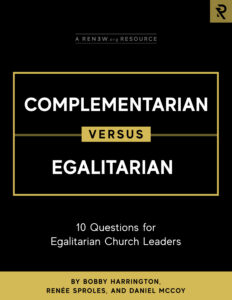
In addition to belief in male leadership in the Greco-Roman culture, the synagogue and Jewish culture also believed in male leadership authority.
The Jewish beliefs were based on what God had established in the Old Testament. God created a nation and built male headship into the practices of the nation. Male headship is embedded in the entire Old Testament. Here are some examples.
- The selection of Abraham as patriarchal head of Israel and model of faith, with Sarah in submission to him
- The unique mark of male circumcision in the transmission of the Israelite covenant
- The twelve tribes based upon the twelve male descendants of Jacob
- All the major Old Testament prophets and all the known writers of the Old and New Testament passages were male.
- The God-ordained appointment of male-only priests in the Old Testament—a role that morphed into the male-only rabbi role in the time of the New Testament
Appointing women to be elders-overseers against this pattern would have been a huge, mountain-like change.
The background of this pattern is too often minimized. For example, in the Old Testament pagan world, women regularly served as priests. But God authorized only male priests. They were the teachers of Israel. Again, there are many other Old Testament male headship roles that God created, by design and embedded in Scripture, such as only men serving as priests (teachers) and then rabbis in early Judaism.
“Appointing women to be elders-overseers against this pattern would have been a huge, mountain-like change.”
Then, as we move into the New Testament, the same pattern continues, where Jesus selects only male apostles. And his male apostles appointed only men to serve as evangelists, as delegates of the apostles (Timothy and Titus).
Then the apostles restricted women in contexts where teaching and doctrine was championed. Women were to wear head-coverings to show they were under male headship in the local church when they prayed and prophesied (1 Corinthians 11:3-16). And this was not just a local issue; the principle applied to all the churches in the ancient world (1 Corinthians 11:16). They were to remain silent during the weighing and testing of prophecy (1 Corinthians 14:33-36) because it was a male headship role.
So if we advocate that women were somehow to also serve as elders, who oversaw teaching and protecting the doctrine of the church (1 Timothy 3:2; Titus 1:9), it would be a big change. It just does not make sense that it was not discussed in Scripture if this change were intended.
This change would have been so new, so “outside their box” that Paul would need to take pains to describe a whole new way of thinking. Where are the chapters and clear descriptions dedicated to that shift?
It is difficult to believe that this would be a change just inferred in 1 Timothy 3. It would have required paragraphs and even chapters, not contested nuances of pronouns and adjectives. It would have been a situation where the original recipients would have been able to say: “Wait, did you catch that? Did you hear how Paul clearly said women are now to be appointed as elder-overseers too, and given authority that was only previously given to men?” Paul did not make those statements.
“It just does not make sense that it was not discussed in Scripture if this change were intended.”
Again, if the early church appointed women elders, it would have been such a radical change that it would have required explicit teaching.
5. Why Prohibit Women from Teaching and Exercising Authority—Then Immediately Appoint Women as Elders with Teaching Authority?
It is logically incoherent to claim that 1 Timothy 3:1-7 opens the office of elder-overseer to both men and women when the verses immediately preceding it explicitly prohibit women from teaching or assuming authority over men in the gathered church.
Paul states the prohibition with clarity in 1 Timothy 2:11-12:
“A woman should learn in quietness and full submission. I do not permit a woman to teach or to assume authority over a man; she must be quiet.”
This text flies in the face of the role of a female elder-overseer—for the role is fundamentally one of teaching, doctrinal oversight, and authoritative leadership of the entire congregation (see Titus 1:9—“able both to exhort in sound doctrine and to refute those who contradict it”; see also Acts 20:28-31). Again, if these responsibilities were assumed by women, as elders, they would directly contradict the prohibition in 1 Timothy 2:12.
Egalitarian interpreters often argue that Paul’s restrictions in 1 Timothy 2 were temporary and situational—intended only to correct disruptive, untaught women who had been led astray by false teaching in Ephesus. They claim these verses do not establish a universal principle for the church in every age.
This interpretation faces serious problems:
- It contradicts the text’s own reasoning. Paul grounds the prohibition not in local Ephesian culture or a specific crisis, but in the order of creation itself: “Adam was formed first, then Eve” (v. 13) and the account of humanity’s fall (v. 14). These are universal, pre-cultural realities.
- It contradicts the rest of Scripture and the historic understanding of the church. For nearly two millennia, the mainstream of Christian interpretation—across Catholic, Orthodox, and Protestant traditions—have read these verses as establishing a normative pattern of male leadership in teaching and governing roles.
“It is logically incoherent to claim that 1 Timothy 3:1-7 opens the office of elder-overseer to both men and women when the verses immediately preceding it explicitly prohibit women from teaching or assuming authority over men in the gathered church.”
Even if we temporarily grant the egalitarian premise that the prohibition applied only to the Ephesian church, an even deeper contradiction emerges:
Paul would then be instructing the very same Ephesian congregation:
- Not to allow women to teach or exercise authority over men in the church gathering (2:12), and then
- Just three verses later, to appoint women as elders-overseers—who must be “able to teach” (3:2) and exercise pastoral oversight over the entire congregation.
This requires Paul to reverse himself without any explanation or transition—an abrupt 180-degree turn—in the space of a few sentences. Such a sudden, unannounced reversal is implausible and strains the text beyond reasonable interpretation.
Stated plainly: The clear prohibition against women teaching or exercising authority in the gathered church (2:12) followed immediately by the requirement that elders must be “able to teach” (3:2) makes coherent sense only if Paul is describing qualified male elders-overseers throughout 1 Timothy 3:1-7. Any other reading forces the text into unnecessary and convoluted contradictions.
I have not found an egalitarian scholar who can explain this big reversal. Even if it only applies to the local situation in Ephesus—it still makes no sense.
Conclusion
Here is a summary of the new argument in favor of women elders in 1 Timothy 3 and the response.
CLAIM: When 1 Timothy 3:1 says “if anyone” desires to be an overseer, it is a gender-neutral term, inclusive of both male and female.
RESPONSE: Yes, if we only had this verse to follow, it could apply to women, but it would go completely against first-century culture and practice to read it that way.
CLAIM: There are no male pronouns in the virtue list. The Greek is idiou (meaning “one’s own”); the pronoun is gender neutral instead of masculine.
RESPONSE: No, some of the key words are best understood as masculine.
CLAIM: There is nothing explicitly male in the virtue list. Teaching, violence, and managing a household are not exclusively male behaviors.
RESPONSE: No, some of the elements in the virtue list are best understood as masculine—especially the headship role of the man as leader of his family.
CLAIM: “One-woman man” is an idiomatic expression of fidelity; a “one-woman man” functions as a generic masculine term for marital fidelity.
RESPONSE: No, there is a corresponding expression for women (a “one-man woman”) and it is used just two chapters later in 1 Timothy 5:9 for widows—so if women elders are intended, it should be used in 1 Timothy 3, but it is not.
CLAIM: “One-woman man” also refers to female deacons in 1 Timothy 3:12, who are also described as “one-woman men.”
RESPONSE: No, men and women are authorized to serve as deacons in 1 Timothy 3:8-11, but Paul refers back to a special category of male-only deacons in 1 Timothy 3:12-13.
“Some of the key words are best understood as masculine.”
I conclude that 1 Timothy 3 does not authorize women to serve as elder-overseers in the local church and that the other New Testament passages on male headship and elder-overseer roles match this perspective. Only qualified men align with the profile of those to be appointed as elders/overseer-pastors.
It is a difficult thing to uphold this teaching in North American culture. But Scripture requires that we courageously uphold it.
God created men for a special headship role in the home; they are servant leaders, ministering in their role like Jesus to their wives and children. God also created the elder role in the church, for qualified, character-based men; they are servant leaders, ministering like Jesus to the extended church family.
[1] Everett Ferguson, Women in the Church: Biblical and Historical Perspectives, 2nd Edition, Willow Publishing, 2015.
[2] Marg Mowczko, “Women Elders in Ancient Christian Texts (Part 3)”, https://margmowczko.com/women-elders-ancient-inscriptions/, accessed May 15, 2023.