



“For to us a child is born,
to us a son is given,
and the government will be on his shoulders.”
—Isaiah 9:6a (NIV)
Jesus was born into a politically charged world.
Rome occupied the land. The Jewish people neither trusted nor welcomed their occupiers—and, truthfully, most Romans despised the Jews just as deeply. The birth of Jesus took place amid resentment, fear, and competing visions of power.
Hatred is often the human response to clashing political priorities. When your side holds power, it can feel like my values, beliefs, and hopes are being suppressed. This has always been how it is. Human beings naturally place enormous weight on government—and on the politics that shape it—believing that the right political outcome will secure our future.
Jesus was born to be our king. In the New Testament, no figure is more transparent about this than King Herod. Herod was a compromised ruler: Far from being “born king of the Jews,” Herod was not even Jewish but was installed by Rome and made responsible for governing the Jewish people (Matthew 2:1-16). He understood something deeply unsettling: a new political reality would be an existential threat to his reign.
Political power—then and now—is tenuous.
So when Herod heard about the birth of one who would be “born King of the Jews,” he responded with raw political logic. Feeling threatened, he attempted to eliminate the danger by ordering the slaughter of all the baby boys in Bethlehem (Matthew 2:16). That is politics in its most unfiltered form—fear-driven, ruthless, and self-protective.
Politics, at its raw essence, is often like this.
Politics can make us hate one another.
Today, politics in North America is changing. It is taking on deeper meaning and, in many cases, is morphing into something distinctly religious.
“Politics in North America is morphing into something distinctly religious.”
Just because people attend church does not necessarily mean King Jesus is the center of their faith. And just because people attend a Christmas Eve service does not mean they are seeking heaven’s peace. This Christmas season, many may be more focused on the latest political headline than on the angelic announcement of good news.
We are seeing this across the spectrum. Some Democrats now sacrifice for their party and its narrative as if it were a moral absolute. Some Republicans do the same—sometimes even justifying behavior in political leaders that Christians must never excuse or deify, no matter how defensible they find certain policies to be.
For many people—especially as Judeo-Christian beliefs move from being assumed as “common sense” to being labeled “radical” or “regressive”—politics has stepped in to fill the space that religion once occupied. Political ideology now offers what faith communities historically provided: meaning, identity, belonging, and moral clarity.
For Christians on the right, it can feel natural to believe conservative politics is the way to lead the nation back to God. For Christians on the left, it can feel natural to assume anyone to the right is a Christian nationalist trying to legislate Leviticus.
Both sides, however, are vulnerable to the same mistaken belief:
Politics will save us.
That is what Herod believed.
That is what many believe today.
They are wrong.
The ultimate political reality was established with the coming of Jesus the Messiah. Daniel 2:44 (NIV) declares it plainly:
“In the time of those kings, the God of heaven will set up a kingdom that will never be destroyed.…It will crush all those kingdoms and bring them to an end, but it will itself endure forever.”
“In the time of those kings, the God of heaven will set up a kingdom that will never be destroyed.”
Jesus came and established a kingdom that will outlast—and ultimately surpass—every earthly kingdom. Because of that, all politics today are secondary priorities.
When politics becomes semi-religious, it draws us back into Herod’s world—a world of fear, division, and anxiety. Politics begins to dominate our thinking. Our hope becomes tethered to elections. Our future feels fragile.
The birth of Jesus reminds us that every government, every platform, every ideology is secondary to the reign of King Jesus.
From that truth flow three practical priorities.
1. Our Politics Must Be Surrendered to Jesus
We are writing from the United States—a nation as divided as we have seen in decades. Political assassinations. Mass shootings. Each side assigning the worst possible motives to the other. Social media is filled with rage—whether it is people celebrating the death of a political opponent or a president blaming a political enemy for his own murder.
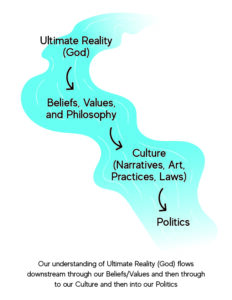
We are experiencing these severe political conflicts because we are losing our foundations, with many veering into right and left extremes. It feels chaotic. Winston Churchill once observed, “In a democracy, you get the politicians you deserve.” Andrew Breitbart remarked that politics is downstream from culture. But this is also important: culture is downstream from values and beliefs and our beliefs are downstream from what we think about God.
Jesus was born to give us a true understanding of ultimate reality (John 1:1; John 18:37). So, what does it look like to be people shaped by the politics of Jesus in a divided nation? It means we go back upstream.
It begins with recognizing Jesus as the ultimate source of our hope and advocacy.
In a democratic system, many people today are immersed almost entirely in politics. But politics flows from culture, culture flows from values and beliefs, and those values and beliefs ultimately flow from what we believe about ultimate reality—about God.
That raises an uncomfortable but necessary question:
Which religion is discipling us?
Consider the competing narratives offered 24/7 by major news networks. They might as well be reporting from different planets. Each side frames itself as the defender of truth and the other as an enemy of all that is good. More and more Christians are absorbing these narratives with sheep-and-goats urgency.
“More and more Christians are absorbing these narratives with sheep-and-goats urgency.”
Many in our churches have been discipled by media into cycles of outrage and fear—none of which resemble the peace of Christ.
This Christmas, invite people into the true religion—the one that offers peace with God, peace within ourselves, peace with our neighbors, and even peace with our enemies, as far as it depends on us.
Let us invite people to prioritize Jesus again. He is the One we ultimately rely upon for our beliefs, values, philosophy. He is the One we need to form our culture, as we win people over to look to Him—and then He alone can help us frame a right, healthy view of politics. He alone is our King, our ultimate political allegiance.
2. In Our Faith, God Guides History
At Christmas, Jesus entered human history.
Christian faith is not about escaping history, as in some religious traditions. God entered history. If human history were a ship, Jesus climbed aboard, took the helm, and began steering it toward redemption. 
This is why societies shaped by Christianity have historically enjoyed fruits such as the dignity of human life, care for the poor, the rule of justice and truth, and the sanctity of of marriage.
In the United States, many Judeo-Christian beliefs shaped our institutions—though imperfectly applied. Today, those assumptions are increasingly replaced by secular frameworks, particularly Marxist oppressor-oppressed narratives and expressive individualism, where inner feelings—especially sexual ones—are treated as morally authoritative.
Many conservatives rightly fear the loss of societal fruit that grew from a Judeo-Christian consensus. In response, some seek to reclaim Christian values primarily through politics—even though politics is not where transformation begins.
The debate matters. The consequences are real.
But regardless of where our nation goes, the helm of history is secure.
The story that matters most ends with “a great multitude that no one could count, from every nation, tribe, people and language, standing before the throne and before the Lamb” (Revelation 7:9, NIV).
Christmas celebrates the birth of a King whose reign will fill the earth and last forever. That is more than enough reason for deep joy whatever the headlines.
“Christmas celebrates the birth of a King whose reign will fill the earth and last forever.”
3. Advancing the Reign of Jesus Is Everyone’s Calling
Where do values and beliefs come from?
For us, they come from Jesus.
Advocate for political views that honor truth and bless people. Vote wisely, like Jesus was in the booth with you. But as disciples of Jesus, our primary focus can and should be on root issues that move the needle in the long term.
That means every believer has meaningful work to do. Like the shepherds on the first Christmas, our response is twofold: we worship—and we tell others (Luke 2:8-20).
“Glory to God in the highest heaven, and on earth peace to those on whom his favor rests.” (2:14, NIV)
“When they had seen him, they spread the word concerning what had been told them about this child.” (2:17, NIV)
Worship reshapes values. Sharing beliefs through disciple making helps others to learn the joy.
If we want to see real change in our world, it begins by spreading Jesus’ values and beliefs—one person at a time. If you want to pierce the darkness with light, this is the way.
“If we want to see real change in our world, it begins by spreading Jesus’ values and beliefs—one person at a time. If you want to pierce the darkness with light, this is the way.”
We make disciples of King Jesus. We get to proclaim the ultimate reality that should frame all our everyday political realities. And that is good news—for Christmas, and for every day that follows.
Politics won’t save us; Jesus will. So we seek to disciple everyone into this true view of reality and see Him shape the values and beliefs that follow.
Merry Christmas to all, for a child has been born to us!
Go further: Browse the complete Christmas resources hub.