

When recommending a book on disciple making to someone, I occasionally hear the remark, “The only book we need is the Bible!” In one sense I agree with that statement. If someone was given the choice of only ever reading one book, I agree it should be the Bible. This of course raises the question, “Why should we read other books besides the Bible?”
I think we can find a good answer in the Bible itself: Mark 7. This chapter opens with the discourse between Jesus and the Pharisees (and teachers of the law) about Jesus’ disciples not ceremonially washing their hands before they eat, as was “the tradition of the elders.”
Jesus replies with several comments about the traditions and teachings of the Pharisees:
“…their teachings are merely human rules.” (7:7b, NIV, quoted from Isaiah 29:13)
“You have let go of the commands of God and are holding on to human traditions.” (7:8, NIV)
“You have a fine way of setting aside the commands of God in order to observe your own traditions!” (7:9, NIV)
“Thus you nullify the word of God by your tradition that you have handed down. And you do many things like that.” (7:13, NIV)
“Thus you nullify the word of God by your tradition that you have handed down. And you do many things like that.”
The Pharisees and teachers of the law had the scriptures, the Word of God, readily available to them and large portions of it memorized. However, they had allowed their traditions, which were intended to enforce the scriptures, to become more important than the scriptures themselves. The last statement by Jesus, that they “nullify the word of God by [their] tradition,” is perhaps the most concerning. The Pharisees and teachers of the law had allowed their traditions to drown out Scripture to the point that their teaching of Scripture was ineffective. Even though they possessed and taught the scriptures, it was to no effect.
A similar predicament can occur today. Churches can allow human traditions to creep in and effectively drown out Scripture. Such a church can claim to be “teaching the Bible” but in reality are only teaching their traditions that are loosely based on Scripture or based on Scripture taken out of context. Such a church might say, “The only book we need is the Bible!” but they are actually teaching manmade traditions which sound like they came from the Bible.
Let me clarify that it is not only “traditional” churches that allow their traditions to drown out Scripture. Contemporary Christian music is a tradition just as hymns are a tradition. Teaching from a pulpit or a small round table is a tradition. Pews and chairs are both traditions. The KJV and the NIV are both traditions. Any practice not explicitly stated in Scripture, regardless of how long it has been practiced, is a tradition. Some traditions in and of themselves are not harmful and may actually accentuate the teaching of Scripture. But all traditions, new or old, can also inadvertently be taught in place of Scripture as if they were Scripture. 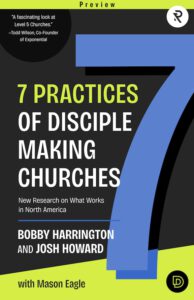
“All traditions, new or old, can also inadvertently be taught in place of Scripture as if they were Scripture.”
This is why we occasionally need someone to come along and point out when we have allowed traditions to “nullify the word of God” in our churches. Generally, this also means that we need it pointed out where we are not teaching or following Scripture where we should, that is, where we have “nullified” it. For those of us who accidentally veer from the teachings of Scripture—all the while believing we’re following it—it can be helpful to have a book point us back to the Bible, pointing where we’ve gotten off and showing us what steps we can take to get back on the path.
Perhaps one of the greatest areas in our churches that we have failed to keep and to teach Scripture is in the area of being and making disciples of King Jesus. By our traditions, many have “nullified” the scriptures about being and making disciples.
At this point, if a church leader asked me what one book they should read on leading their church to be and make disciples, I would point to 7 Practices of Disciple Making Churches. This would probably not be the last book they would need to read on making disciples, but it is a good place to figure out what they need to do next.
If we claim that the Bible teaches that we should be and make disciples of King Jesus, then we should also be able to point to churches that are doing exactly that according to Scripture. Moreover, we should be able to identify how these churches have been able to keep the Great Commission effectively where other churches have come up short.
“If we claim that the Bible teaches that we should be and make disciples of King Jesus, then we should also be able to point to churches that are doing exactly that according to Scripture.”
To my knowledge, 7 Practices of Disciple Making Churches is the only book that correctly identifies specific churches in North America that are keeping the Great Commission at a high level—the level of the everyday culture of the church—and identifies the practices that allow them to do so.
If while taking a test that you were unprepared for, you were allowed to work in a group with the kid with the highest grades in the class, why would you not? If you believe that Scripture teaches that we should be and make disciples of King Jesus, and you are unsure of exactly how to accomplish that, why would you not take an in-depth look at churches that can prove they are successfully being and making disciples of Jesus and can tell you how they are doing it?
I have been studying discipleship for quite a while now and I was pretty sure what 7 Practices of Disciple Making Churches would say when it came out, but I was still excited to read it because I wanted to know for sure. Moreover, I am excited to have a resource that I can point church leaders toward that proves that churches with an everyday culture of being and making disciples of Jesus are possible in North America and explains how it can be done.
Find all of our book reviews and reading guides in one place.