

I knew a young woman who started dating a guy and—within weeks if not days—she got his name tattooed on her leg. You can guess where this is going. Yeah, they broke up shortly thereafter. Oopsies!
Enter the cover-up tattoo artist, a uniquely skilled individual who can take whatever you have and turn it into something else. At least that’s the hope. So the boyfriend’s name became a weird-looking rose.
The same thing happened for a guy I hired to lay flooring. He said he got tired of getting hassled by the cops for his marijuana leaf arm tattoo so he had it turned into a five-horned demon. It kind of looked like a marijuana leaf with a quirky face, if you ask me.
I was chatting with a guy at Firehouse Subs. He had a tat of a molecular structure that intrigued me, so I had to ask. He said, “I was young and dumb and accidentally got THC not adrenaline.” I’m sure you change the molecular structure of that somehow, right?
I know a fella who had the name and dates of a close friend who died tattooed on his shoulder. Okay, that’s understandable, I thought. When I looked closer, emblazoned on a banner were the words “Never fogotten.” Yeah, they forgot the “r”—oh the irony! And no, I didn’t mention it.
“Enter the cover-up tattoo artist, a uniquely skilled individual who can take whatever you have and turn it into something else.”
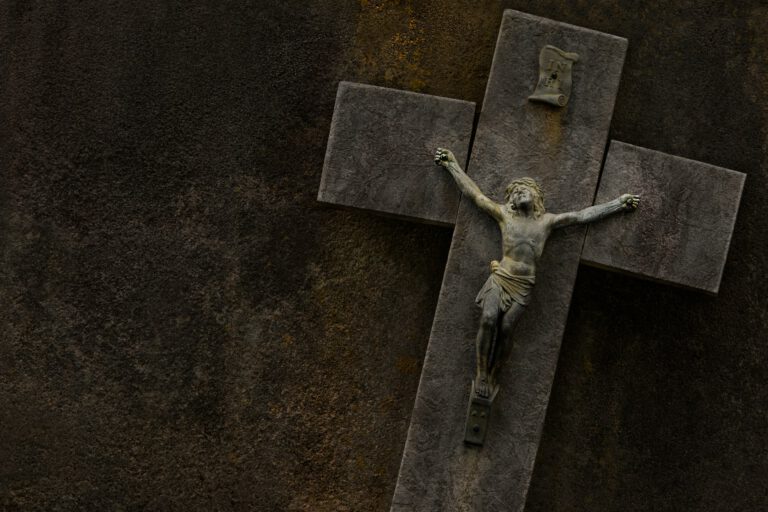
But I did pick up a conversation with a guy outside of Chipotle the other day. His face was covered in tattoos, even his eyelids. I noticed a cross on his arm and asked him his story. He said he is now a recovering addict and follower of Jesus. When he was young, he went to a church and even “got saved” but was a little wild and got a tattoo. His church told him he was going to hell, so he thought, “I might as well have fun while I’m at it.” And then came the kicker—he said, “The church didn’t know how to disciple me but the gangs were good at it.”
“Follow me.” It’s a call to be a disciple, a learner, an apprentice. Jesus made it clear that this was a universal mandate, not just for the dudes who were to become his twelve apostles: “Then Jesus told his disciples, ‘If anyone would come after me, let him deny himself and take up his cross and follow me’” (Matthew 16:24, ESV, emphasis added). Note that he says “anyone.” The parallel passage in Mark 8:34 explicitly indicates he spoke to the crowd, not just the disciples.
Similarly, Jesus instructs Philip and Andrew to relay to a group of Greeks who were curious about him: “If anyone serves me, he must follow me…” (John 12:26, ESV). And to the rich young ruler who inquired of Jesus, he said “come, follow me” (Matthew 19:21, Mark 10:21; Luke 18:22). By way of comparison, Jesus explicitly commands faith or belief in him only two times (John 14:1, 11). So Jesus seems to call people to follow him just as much as (if not more than) to believe in him.
“Jesus seems to call people to follow him just as much as (if not more than) to believe in him.”
What does all this mean? It means every aspect of life, and every decision, somehow filters through the grid of growing in Christlikeness not just theological or doctrinal knowledge. Becoming an apprentice of Jesus to become like Jesus is not just at the core of life in relation to God; it could be called the essence of life itself.
So how might getting tattooed relate to Jesus’ command to “follow me”? This question gets at the heart of the call to be a disciple (aka apprentice) of Jesus, to follow his footsteps and emulate his life.
On a literal, physical level, we have no evidence of Jesus being tattooed in his earthy life. So, no, being like Jesus doesn’t mean being tattooed. But might Jesus’ example indirectly endorse tattoos?
Revelation 19:16 (ESV) describes Jesus’ return from heaven on a white horse to destroy evil on the earth with this unique detail: “On his robe and on his thigh he has this name written: king of kings and lord of lords.”
“Becoming an apprentice of Jesus to become like Jesus is not just at the core of life in relation to God; it could be called the essence of life itself.”
Some of the theories for what this means include:
- Jesus has a tattoo showing on his upper leg as his robe flaps back when he charges forward. If this is the case, based on v. 16, he also has the same matching words embroidered or screen printed or somehow otherwise visible on his robe.
- It’s talking about a banner or sash that falls to his thigh with those words written on it.
- Maybe it’s a sword scabbard, also falling to his thigh, inscribed with the titles. Ancient kings, it is believed, were thought to enjoy doing this kind of thing.
- If Revelation was originally written in Hebrew, not Greek, then there could have been a scribal copying error with the first letter of the Hebrew word “banner” (dagel) looking almost identical to the first letter of the Hebrew word for “thigh” (ragel). The scribe mistook “On his robe and on his banner…” for “On his robe and on his thigh…”
- This apocalyptic scene is saturated with highly symbolic language and is not intended to be taken literally. Jesus doesn’t have a stack of many crowns precariously balanced on his head (vs. 12), a dripping, blood-saturated robe (v. 13), or a sharp sword presumably cutting the corners of his lips as it protrudes (vs. 15). And he doesn’t have an ancient form of a graphic t-shirt or thigh tattoo.
Which is it? Well, as with other areas of biblical interpretation, a proper attempt to answer this question would involve robust study of the significance of the thigh in the ancient Near Eastern literature, a thorough review of archaeological findings to discern pictorial representations of ancient kings, semantic studies of all the terms with source and text-critical evidence for or against allegations of a scribal typo, and a healthy dose of humility.
“This apocalyptic scene is saturated with highly symbolic language.”
My view is that there is sufficient reason to be hesitant about the theory of Jesus having a thigh tattoo, so someone should look elsewhere if they’re going to find justification of Jesus’ supposed endorsement of tattoos. Besides, even if he was literally inked with his title on his thigh, a consistent literal application would be to get your title tattooed on your thigh (and with corresponding verbiage on your robe), which I’m pretty sure is not something advocates are suggesting.
And yet it would also be too simplistic to say Jesus’ explicit call to “follow me” has absolutely nothing to do with any of us getting or not getting tattoos. If the mandate of our lives is to be shaped and molded into the character of Christ, imitating His values, taking on the mind of Christ, and advancing His Kingdom (Romans 8:29; 1 Corinthians 11:1; 2 Corinthians 3:8; 1 John 2:6), then there are redemptive and missional impulses clearly evident in King Jesus that could move someone to get tattooed. Let’s think about what those could be.
Incarnational theology emphasizes becoming “one of” the people we dwell with, just as Jesus came to us and “became flesh” (John 1:14), pitching his tent among us as a fellow human being.
“Have this mind among yourselves, which is yours in Christ Jesus, who, though he was in the form of God, did not count equality with God a thing to be grasped, but emptied himself, by taking the form of a servant, being born in the likeness of men.” (Philippians 2:5-7, ESV)
“Incarnational theology emphasizes becoming “one of” the people we dwell with, just as Jesus came to us and ‘became flesh,’ pitching his tent among us as a fellow human being.”
Faithful followers and astute theologians alike have wrestled and marveled with this passage for millennia now, and the general orthodox consensus is that he didn’t empty himself of his divinity when he took on humanity. Rather, Jesus voluntarily chose some form of relinquishing access to his divine prerogatives for some period. In other words, he willingly released what he could (or even rightfully should) have to fully relate to the people he came to save.
Implication: as we follow Jesus’ example of intentional, proactive identification with a lost and dying world, we willingly release our rights and expectations to better identify with the people of our mission field. Could this involve a change of physical appearance as part of a contextualization? And if the target demographic we feel called to reach was distinguished by visible tattoos, could that potentially be a strategic way to build bridges? 
Just a few days ago, a total stranger approached me in a park where I was helping set up a few things for a wedding. He asked when the wedding was and who I was. I told him I was the father of the bride, and he said, “Oh, I thought you were a priest or something,” and then he commented on the tattoos on my arm and curiously asked “What do you do?” I said I was also a pastor, gave a super short explanation about the meaning of the tattoos, and said I’d love to talk more with him. I’m excited we will meet later today. So, did the tattoos help me establish rapport with this long-bearded, tattooed guy? It sure seems so, and now there is a bridge for sharing the gospel.
“Did the tattoos help me establish rapport with this long-bearded, tattooed guy?”
A term missionaries use for this is “contextualization.” After making the case for his rights to eat and drink, to take a believing wife, and to not have to work for a living while advancing the gospel, the apostle Paul explains why he chooses to forfeit those very rights. Then he details the nature of and motive for his contextualization to different kinds of people:
“For though I am free from all, I have made myself a servant to all, that I might win more of them. To the Jews I became as a Jew, in order to win Jews. To those under the law I became as one under the law (though not being myself under the law) that I might win those under the law. To those outside the law I became as one outside the law (not being outside the law of God but under the law of Christ) that I might win those outside the law. To the weak I became weak, that I might win the weak. I have become all things to all people, that by all means I might save some. I do it all for the sake of the gospel, that I may share with them in its blessings.” (1 Corinthians 9:19-23, ESV, emphasis added)
I know a pastor in our city whose church uses the name 922 based on this passage in 1 Corinthians. The first time I visited a worship gathering, I was struck by all the motorcycles lined up outside. Inside the dark, packed-out auditorium were a lot of young men and burly, tattooed dudes. When the pastor stepped onto the stage for the Bible teaching, I could see tattoos on his neck above his shirt and covering his arms.
“The first time I visited a worship gathering, I was struck by all the motorcycles lined up outside.”
Later I learned he was the owner of a tattoo business with three locations and that he had met Jesus and been called to vocational ministry. The tattoos were a part of his life before following Jesus, and yet God continues to use those visible marks to create curiosity and build trust with people who may not naturally feel it with organized expressions of Christian faith. I thought his comment about wishing he had saved more skin real estate for God stuff was intriguing.
To sum up this idea so far, the call to follow Jesus—because of his incarnational example—may lead some of his followers to outwardly identify with the audience they are seeking to reach with the gospel, and visible tattoos could be one way to do so alongside clothes, hairstyles, and other ways of looking.
And yet at the same time, held in tension with this idea, is Jesus’ teaching about “let your light shine before others, so that they may see your good works and give glory to your Father who is in heaven” (Matthew 5:16 ESV). The driving motive here is more people glorifying God, and letting the light of your good works shine is the means to that end. It’s our works in view here, not physical outward appearance, that are the means of witness. This would align with the prophetic description of Jesus as “blending in” with his outward appearance: “he had no form or majesty that we should look at him, and no beauty that we should desire him” (Isaiah 53:2 ESV).
Whatever steps you might take to build bridges to people, never lose sight of what glorifies God more than external appearance: letting God’s glory shine through works of genuine love. That’s the truest marker of a disciple of Jesus.