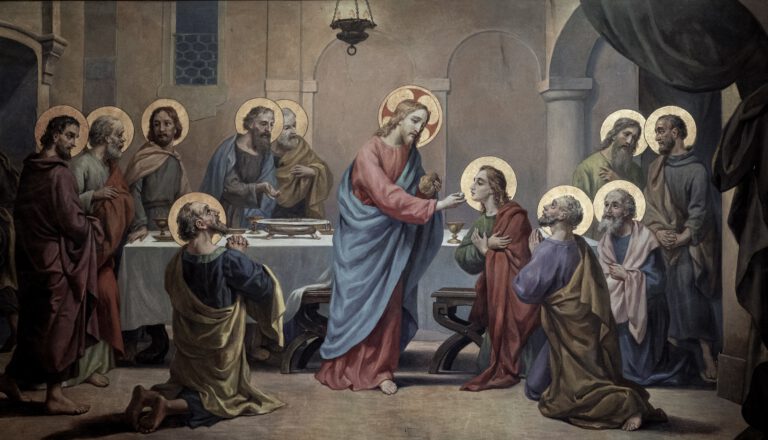



Jesus’ tactics varied widely. He spoke to large crowds, spent much time with his disciples and confronted religious hypocrisy. He healed people and cast out demons. But his varied tactics all linked together in a continuum. Each part fit with all the other parts, pointing toward a common goal—the kingdom of God.
In order to reach nations at “the ends of the earth,” Jesus first gathered a substantial crowd, then culled out all but a few people. Settling on 12 men and a few women, he singled out just three—Peter, James, and John—for His inner circle. From these few, He launched the greatest movement in human history.
Unfortunately, we struggle to find evidence in the book of Acts that these three, who were closest to Jesus, engaged in disciple making the way He did. They must have made disciples, but if they did, their activity is not recorded in Acts. We do see a natural progression of growth in the deacons Stephen and Philip. However, there is nothing concrete to say that their growth was the result of one-on-one contact with any of the apostles. It looks as if the apostles were so busy running what had quickly become a mega-church that they had little time for disciple making.
“From these few, Jesus launched the greatest movement in human history.”
We see the method picked up by a former Christ-hater named Saul, as he learned to imitate Jesus as a disciple maker. He would first get knocked off his horse, see a vision, and hear the voice of Jesus in a scary conversion experience while on his way to persecute Christians in Syria. During this frightening event, Saul was told that while in Damascus he would be shown what he must do. It follows that at least some of what he was shown was the strong validity of imitating Jesus by making disciples. Saul had plenty of knowledge of the early Christians and may have even seen Jesus before the crucifixion. He would easily have been aware of Jesus’ strategy and methods. 
Saul, also known as Paul, figures so strongly in the book of Acts that it might well have been called “The Acts of an Apostle.” He takes center stage in 21 chapters of the book of Acts. Contrast this to the fact that Peter appears in only 11 chapters, while James shows up in just 3, and John in only 4. It was Paul whom Luke describes in Acts as always traveling with personal disciples. Through his efforts, Europe was eventually Christianized, leading toward ministry that would reach the ends of the earth.
Paul seemed to follow a formula. Wherever he went he did three things: He proclaimed the gospel (often accompanied with miracles); he made disciples; and he appointed some of those disciples as elders or pastors to care for the other disciples.
“It was Paul whom Luke describes in Acts as always traveling with personal disciples.”
Even after having been stoned and left for dead in Lystra (see Acts 14:8-23), he sneaked back into the city and appointed elders. This act would suggest that he planted a viable church. It may have been quite small, but size has little to do with viability. Pioneer movements usually start from a small place. The people he appointed would have been his disciples—though he apparently had little time to invest in them prior to the attempt to kill him. My point is that he preached, made disciples, and appointed some of them to oversee new churches. This was highly productive, and the end result was huge. In making disciples, Saul/Paul imitated Jesus. His efforts give us a clue to our own potential success: copy Jesus; it works well!
This doesn’t mean we will live-out all our tactics from the pages of the New Testament. Meeting places, marketing programs, and great music are tactical tools. As tactics, they are always open to change while the goal and the strategies of Christ seem unchanging. Tactics are quite fluid; strategy is not.
To understand this better, think of a battlefield. The mission is always to break the enemy’s will to fight. The strategies are set before the battle begins, as are most of the tactical arrangements. But when the fighting starts, innovation begins almost immediately. This is because soldiers on the ground face unexpected and often rapidly changing environments. Strategies remain constant while the battlefield dictates the adaptation of tactics to best suit the situation.
“Tactics are quite fluid; strategy is not.”
An example of this would be the use of tanks in World War II. In the European theater, American tanks were smaller, more lightly armored, and outgunned by the German tanks. While battle planners had intended head-to-head slug-outs between tanks, our troops quickly learned they had to maneuver behind the Germans in order to shoot at the poorly armored rear of the enemy tanks. Tactics had to change to exploit the enemy’s weak spot. Yet, even as tactics changed, the strategy was always to break the enemy’s will to fight.
What am I trying to say here? You are not supposed to (and you cannot) improve on the mission (the global reign of Jesus’ kingdom) or the strategies (disciple making, baptizing, and teaching obedience) of the Great Commission. However, when it comes to tactics, do what works—even if it means spending more time on the golf course, more time surfing, or more time hanging out at Starbucks. Think about whatever Jesus or Paul might do if they walked the streets of your town.